As the seasons change, so do the strategies we use to manage horses’ hooves
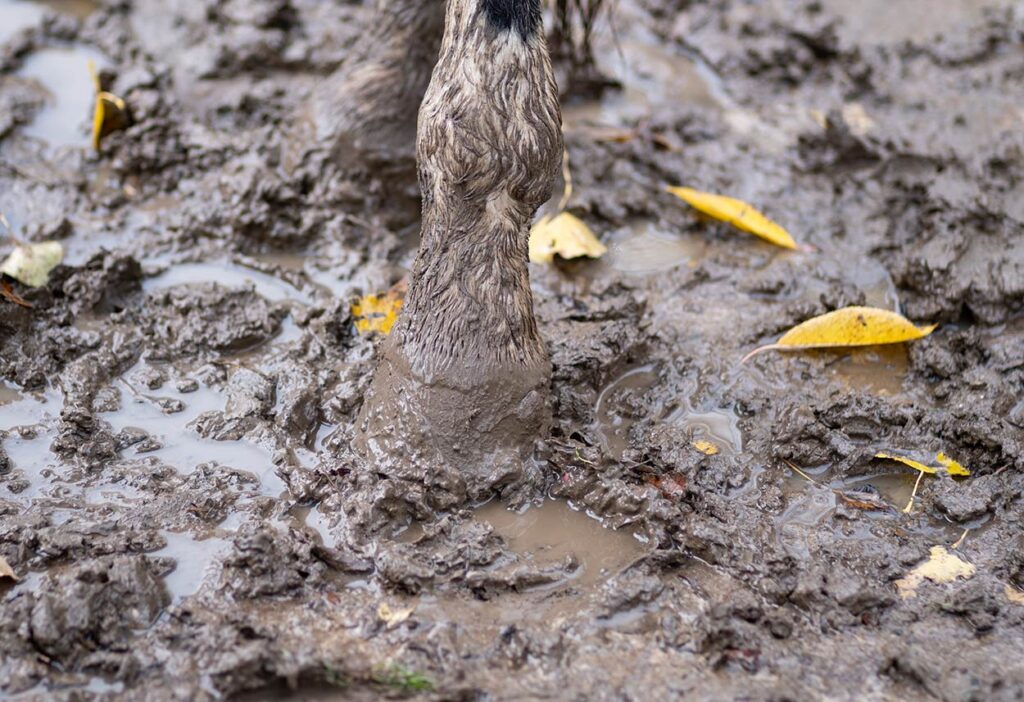
Because horses’ hooves function as living, responsive structures, their health and strength often reflect the environmental stressors they encounter. And as most horse owners have experienced firsthand, horses frequently face pesky climate-specific hoof health problems—thrush, abscesses, or hoof cracks—because varying moisture levels, temperatures, and terrain conditions can all challenge the structural integrity of the proteins that make up hooves.
Beyond stall-side observations, the scientific community has also established that the environment has a profound effect on horses’ feet.1 While we can’t control how harsh the next winter might be or how badly the subsequent April showers will flood our pastures, we can take some season-specific proactive steps to mitigate seasonal hoof health challenges.
Your Horse’s Hooves Interact With Their Environment
The rainy fall and spring seasons notoriously bring moisture-related conditions, while hard (potentially frozen) ground contributes to hoof cracks in the summer and winter.
“Temperature and moisture fluctuations can have profound effects on hoof health due to the structural composition of the hoof, which consists primarily of the fibrous structural protein keratin,” explains Jason Williamsen, a farrier based in Warwick, New York.
“For that reason, starting off with strong, robust feet, whether barefoot or shod, makes it much easier to prevent many commonly occurring issues that haunt feet with thin, shelly walls and shallow soles,” adds Ric Redden, DVM, a renowned veterinary podiatrist who established the International Equine Podiatry Center (IPEC) in Versailles, Kentucky, 44 years ago.
“Rapid transitions between wet and dry conditions cause the hoof to repeatedly expand and contract, leading to mechanical stress that can result in microcracks, brittleness, and compromised hoof wall integrity,” Williamsen adds.
“Excess moisture weakens the intermolecular hydrogen bonds within the keratin structure,” he explains. This weakens the horn and creates an opening for bacterial and fungal infections such as thrush (a comon infection of the frog) and white line disease (a degenerative hoof wall infection) to invade. Conversely, dry conditions reduce hoof elasticity, making hooves more prone to fissures, chipping, and sole bruising. We’ve grouped seasonal hoof health challenges into fall and spring, winter, and summer. Let’s dive in.
Fall and Spring Challenges
The main stressors: excessive moisture levels, transitioning between dry and wet conditions, deep mud
Common issues: thrush, white line disease, pulled shoes, subsolar abscesses.
You’ll notice we’ve grouped fall and spring, despite opposing each other on the calendar, because they introduce the same obstacle—endless wetness. As winter either approaches or recedes, excessive moisture in the ground can create ideal conditions for white line disease, thrush, and hoof abscesses to raise their ugly heads. “Prolonged exposure to wet footing is problematic because excessive water is a killer,” Redden says, comparing the hoof wall tubules and matrix to a strong cardboard box. “Cardboard and hooves both weaken with too much moisture.”
“White line disease is a relatively common issue,” he says. The Merck Veterinary Manual defines the condition as progressive and keratolytic (breaking down keratin), affecting the deeper layers of the stratum medium (the middle layer, also the thickest) of the hoof wall. It causes the hoof wall to separate due to crumbling decomposition of the horn at the white line. While the exact cause remains unclear, anaerobic bacteria (those that don’t need oxygen to survive) and fungi likely play a role—either as primary pathogens or opportunistic invaders following initial damage.2 “White line disease can result in lameness issues when the hoof wall defect is advanced enough to trigger a separation of that hoof wall,” Redden says.

As for thrush, this infection happens so frequently that experts sometimes disagree on how clinically significant it is. “Over the years, I have found that many individuals use thrush as an excuse for lameness in the horse,” notes Michael Fugaro, VMD, Dipl. ACVS, owner of Mountain Pointe Equine Veterinary Services, in Long Valley, New Jersey. “I do not agree with that assessment. My interpretation of thrush is (it’s) a superficial accumulation of black moisture within the central sulcus of the frog. These outer tissues are insensitive and should not influence pain sensations of the deeper anatomy of the hoof.”
That said, he warns that if left untreated, thrush can persist and cause tissues to degrade. “As regions of the frog break down and become necrotic, bacterial infections can invade deeper into more sensitive tissues,” he explains. “Once this complication occurs, I no longer consider the issue to simply be thrush.”
Fugaro says in his experience, though, many horses with exposed sensitive and infected tissues on the hoof’s solar surface can remain surprisingly sound. Finally, mushy feet make it easier for horses to lose their shoes—especially in paddocks with deep mud, which can have a suctioning effect. Bacteria can travel into the hoof wall, leading to painful subsolar abscesses. Hoof abscesses can be compared to pimples lodged under human fingernails. Trapped within the rigid hoof capsule, these pockets of pus and debris can’t expand outward, so the pressure builds internally, causing significant pain and lameness.
Prevention and management:
- Clean and inspect hooves daily, removing mud and debris. “A good hoof pick and wire brush can go a long way in treating 90% of diseases of the hoof,” says Fugaro.
- Provide dry turnout areas (fencing off flooded or swampy parts of paddocks if needed) to spare the horses from having to stand in deep mud.
- Ensure regular trimming to prevent flares and cracks that can trap bacteria. “One of the biggest mistakes horse owners make is neglecting regular hoof care, such as skipping farrier visits or not cleaning hooves daily,” which can lead to thrush and white line disease as well as a chronic infection known as canker, says Williamsen.
“Since our domesticated horses aren’t roaming the wild lands and naturally exfoliating their hooves on rocky terrain, we’re responsible for the routine trimming of their feet,” Fugaro explains. “Routinely trimming off excess horn improves the overall health and hygiene of the hoof.” - Use hoof hardeners to help toughen excessively soft hoof walls and soles. Common ingredients known for their hoof-hardening benefits include aluminum chloride hexahydrate, glycerin, formaldehyde, ethyl alcohol, methyl alcohol, and methyl salicylate.3
- Promptly address any suspected hoof abscesses with your farrier or veterinarian’s direction. Treatment often involves wrapping and/or soaking the hoof in antiseptic (i.e., Betadine) and in drawing agents (ichthammol, Epsom salts), and the farrier or veterinarian paring the sole with a hoof knife to dig out the abscess in some cases. Deciding whether to administer the non-steroidal anti-inflammatory drug (NSAID) phenylbutazone (Bute) for hoof abscesses often proves tricky. “I prefer not to administer NSAIDs unless I have to,” Fugaro says. “In years past it was commented that NSAIDs delay abscesses from opening. I don’t think there is any science behind this, but I have delayed NSAID therapy (for hoof abscesses) as much as possible.” The speculation is NSAIDs reduce inflammation so, rather than working its way out, the abscess gets smaller so the pressure can’t produce a place to exit.
Summer Challenges
The main stressors: dryness, hard ground, biting insects
Common issues: dry, brittle hooves, hoof cracks.
Again, in the summer, the combination of heat and dry, hard ground can cause hooves to lose moisture, becoming brittle and prone to cracking. Hard footing can also cause concussive damage, leading to solar bruising and discomfort. Adding insult to injury, pesky bugs swarm, biting horses’ legs and prompting them to stomp their feet. Over time this repeated concussion can leave hooves brittle and cracked.
“In warmer months some barns opt for nighttime turnout,” Williamsen says, offering a solution for the insect problem. However, this reversed turnout schedule can come with its own set of hoof health challenges for horses. “The problems we see from night turnout include softening of the hooves and fungal infections due to prolonged exposure to dewy grass and increased moisture,” he adds.
Prevention and management:
- Apply high-quality hoof moisturizers or conditioners to lock in hydration.
- Provide a balanced diet with adequate biotin, zinc, and amino acids to support the tensile integrity and strength of the hoof’s keratin-rich horn. Focus on meeting your horse’s vitamin and mineral requirements through high-quality hay coupled with either a ration balancer or concentrates as needed before turning to the many hoof supplements available.
“Very few, if any, have been proven to treat, cure, and even prevent hoof-related conditions,” explains Fugaro. “Having an appropriate expectation of each product’s effectiveness is essential.” - When dealing with hard ground, consider using hoof boots on unshod hooves for added protection.
- Attire your horse with fly boots and apply fly spray daily to reduce insect nuisance.
- Pick a turnout rotation (day vs. night) that works for your individual herd.
Winter Challenges
The main stressors: hard ground, icy conditions, excessive moisture, and slow hoof growth
Common issues: sole bruising, hoof cracks, snowballs in feet
Williamsen says he has noticed a seasonally different growth rate in his Northeast clientele, where both summers and winters come with extreme temperatures. For some equestrians in cold climates, hoof cracks or other defects seem to grow out at a snail’s pace in the winter. That’s because cold conditions slow hoof growth, with researchers having shown the most hoof growth happens in either summer or fall (depending on the specific study) and the least in winter.3-4 Researchers generally agree seasons significantly influence hoof growth.5
When it’s bitter cold out but not snowing, “those dry winter conditions can make hooves brittle, increasing the risk of chips and cracks,” Williamsen says. Think of the same frigid, arid conditions that have you reaching for your hand cream and lip balm nonstop. Any conditions that allow the hoof wall to fissure, compromising its integrity, invite bacteria and other pathogens to travel up inside the hoof, potentially resulting in abscesses and white line disease.

“Frozen or uneven ground can certainly lead to hoof bruising and cracks,” he adds. “Snow and ice buildup (in hooves) can cause further discomfort and affect traction, sometimes leading to slips or falls.”
Prevention and management:
- Maintain a regular trimming schedule as recommended by your farrier, even if hoof growth slows, to prevent structural imbalances and hoof cracks.
- Whenever possible avoid excessive exposure to prolonged wet, slushy conditions that could weaken the hoof wall.
- Williamsen recommends applying snow pads, as recommended by your farrier, if you need a more permanent solution. Borium studs can also be added.
Housing Matters
Researchers on a German study made two noteworthy observations: Housing impacts both hoof hardness and the susceptibility of the hoof to seasonal effects. “In open stable housing the horses’ hooves had the highest horn hardness in summer, whereas winter showed the least horn hardness,” the researchers say. “Water content was highest in wintertime. In contrast, such seasonal changes could not be observed in indoor housing.6” Their findings reinforce the idea that the environment influences hoof health and, therefore, at least partly within our control as horse owners, caretakers, farriers, and veterinarians.
Take-Home Message
Preventing seasonal hoof problems starts with consistent care. Veterinarians and farriers agree that diligent hoof care and pasture management off er straightforward, effective ways to protect horses’ feet from the challenges of changing weather throughout the seasons.
References
1. Hampson B. The effects of environment on the horse’s hoof. J Equine Vet Sci. 2011;31(10):609. doi:10.1016/j.jevs.2011. 09.062
2. Merck & Co., Inc. (n.d.). White line disease in horses. Merck Veterinary Manual. tinyurl.com/ycy5p5xs. Accessed April 14, 2025.
3. He Y, Nadeau J, Reed S, Hoagland T, Bushmich S, Aborn S, et al. The effect of season on muscle growth, fat deposition, travel patterns, and hoof growth of domestic young horses. J Equine Vet Sci. 2020;85:102817.
4. Lewis C, Nadeau J, Hoagland T, Darre M. Effect of season on travel patterns and hoof growth of domestic horses. J Equine Vet Sci. 2014;34(7):918–922.
5. Pütz AC. Monitoring of seasonal influences, the effect of housing conditions and domestication on the horn quality of the equine hoof . Berlin: Free University of Berlin; 2006. ISBN: 9783866642119.
6. Holzhauer M, Bremer R, Santman-Berends I, Smink O, Janssens I, Back W. Cross-sectional study of the prevalence of and risk factors for hoof disorders in horses in The Netherlands. Prev Vet Med. 2017;140:53–59. doi: 10.1016/j.prevetmed.2017.02.013.