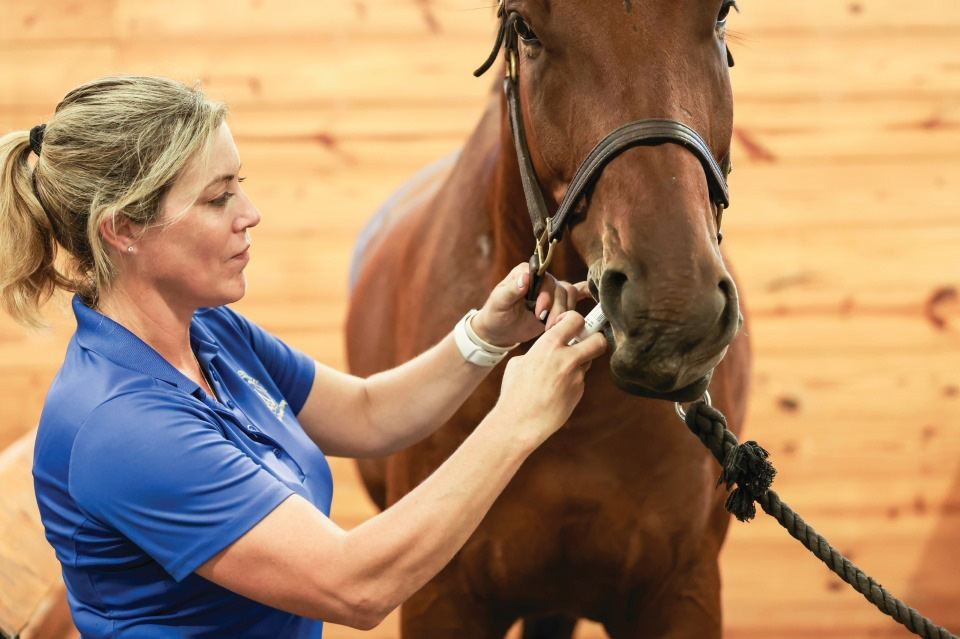
Veterinarians have long relied on non-steroidal anti-inflammatory drugs (NSAIDs) to manage acute and chronic inflammation, with advances improving safety and efficacy. Equine vets commonly use nonselective and COX-1- sparing NSAIDs to treat pain and inflammation. Clear understanding of their mechanisms guides treatment decisions.
Phenylbutazone
Phenylbutazone (Bute) is the oldest NSAID still widely used in equine medicine. Introduced for humans in 1949, vets adopted it in the 1950s. Decades later, it remains a cornerstone in treating pain and inflammation, including osteoarthritis (OA). But its potent analgesic and anti-inflammatory effects come with significant safety concerns. Chronic use is strongly associated with gastric ulceration, right dorsal colitis, and renal damage.
Flunixin Meglumine
The second-most used NSAID in horses is flunixin meglumine. Approved for equine use in 1977, it is the NSAID of choice for soft tissue injuries, inflammation, and fever—particularly GI, respiratory, and eye conditions. Prolonged use can lead to renal toxicity and GI ulceration. It also delays intestinal mucosal healing.
Firocoxib
Firocoxib is the newest NSAID in equine medicine. It was approved in oral paste form in 2005 (Equioxx), then injectable and tablet forms and an oral solution in 2024 (Equicoxib). Known for its strong COX-1-sparing effects, firocoxib has a COX-1-to-COX-2 binding affinity ratio of 1:250, in contrast to Bute and flunixin’s 1:1 ratio. This high COX-2 selectivity allows it to effectively manage OA clinical signs and significantly reduce risk of adverse effects.
Efficacy of Firocoxib
Several studies support firocoxib’s efficacy for treating equine OA. In 2008, Doucet et al. compared firocoxib and Bute in 253 horses with naturally occurring OA-related lameness. After 14 days, 84.6% of firocoxib-treated and 86.6% of Bute-treated horses showed improvement, indicating comparable clinical efficacy.
In 2012, Orsini et al. studied 390 client-owned horses with OA-related pain and lameness across 80 sites. They saw significant improvement in 78.7% (307/390) of cases over the 14-day treatment.
Safety Profile
Firocoxib’s most significant advantage may be its broad safety profile. In the original field efficacy study, only 0.03% treated at the label dose had adverse events.
In a safety study, one horse group received the label dose for 30 days, another received 3X the label dose, and a third received 5X the dose for 30 days. No adverse effects were seen in the label-dose group. The 3X and 5X groups had clinically significant oral lesions, and the 5X group had clinical pathologic abnormalities.
Modern equine medicine depends on a small selection of approved NSAIDs to manage acute and chronic pain and inflammation. Among the three most used options, firocoxib offers clinical efficacy comparable to Bute and flunixin but with a substantially better safety profile. So, firocoxib represents a valuable advancement in the management of OA in horses.
References:
Tobin T, et al. Phenylbutazone in the horse: a review (1986). Maxwell H. Gluck Equine Research Center Faculty Publications. 94.
Flood J, Stewart AJ. Non-steroidal anti-inflammatory drugs and associated toxicities in horses. Animals (Basel). 2022;12(21):2939.
Marshall JF, Blikslager AT. The effect of nonsteroidal anti-inflammatory drugs on the equine intestine. Equine Vet J. 2011;43:140–144.
Doucet MY, et al. Comparison of efficacy and safety of paste formulations of firocoxib and phenylbutazone in horses with naturally occurring osteoarthritis. JAVMA. 2008;232:1.
Orsini JA, et al. Evaluation of oral administration of firocoxib for the management of musculoskeletal pain and lameness associated with osteoarthritis in horses. Am J Vet Res. 2012;73(5):664-71.
Freedom of information summary. NADA 141-253. Equioxx oral paste. 2005.