Veterinary teaching hospitals save horses’ lives and train future veterinarians. But along with the human faculty, another type of staff member has an integral role in training new vets to care for your horse.
“Our teaching horses are very valued members of our teaching facility,” stated Beth Davis, DVM, Dipl. ACVIM, associate professor of Equine Internal Medicine at Kansas State University in Manhattan, Kan.
What does a “teaching horse” actually do? One of their jobs is to donate blood when a critically ill patient requires a blood transfusion. The 10 horses kept at Kansas State are blood typed and those found to be blood type Aa/Qa negative (the equine equivalent of “universal donor”) work as blood donors, along with their other teaching functions.

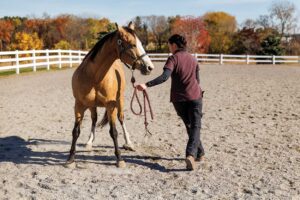
Charlie Brown helps a veterinary student learn to monitor cardiac health.
And it’s not all work for equine blood donors and veterinary teaching horses.
“Some live in groups, and they are often rotated to pasture, depending on their dietary needs and condition,” Davis explained. “They have free choice hay and grain twice a day.”
It is not unusual for teaching horses to be with Kansas State well into their 30s, and they’re often adopted by staff members when retirement does arrive.
“I don’t know what we would do without them,” Davis said. “They are dearly beloved.”
Read about more Dirty Jobs for Horses.
Create a free account with TheHorse.com to view this content.
TheHorse.com is home to thousands of free articles about horse health care. In order to access some of our exclusive free content, you must be signed into TheHorse.com.
Start your free account today!
Already have an account?
and continue reading.