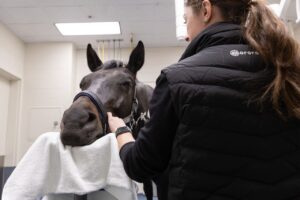
“Some genes that are the focus of gene therapy research for their therapeutic effects may also have a role in athletic performance, and this is where the concept of gene doping stems from,” said Tessa Wilkin, PhD, of the University of Sydney School of Veterinary Science and the National Measurement Institute Bioanalysis Group, both in Sydney, Australia.
By injecting certain genes directly into a horse, handlers might be able to influence performance, Wilkin said. However, scientists have not yet studied the effects—good or bad—of these injections. They might not affect performance, and they could cause severe side effects. It’s even possible the genes could filter through the bloodstream into the reproductive organs.
“This is one of the risks associated with gene doping—the injected gene could then be inherited with unknown effects on the foal,” she said.
Gene doping is not only risky; it’s also unfair, said Wilkin, who led a review paper on the topic, co-authored by Anna Baoutina, PhD, of the National Measurement Institute, and Natasha Hamilton, PhD, from the University of Sydney.
“As well as potentially harming horses, doping is considered unethical by international sports organizations and the International Federation of Horseracing Authorities as it violates the spirit of sport, threatens its integrity, and puts coercive pressure on those competing ‘clean,’ ” the scientists stated in their review, which was conducted with financial support from Racing Australia.
But no gene doping detection tests currently exist. Baoutina has led experiments based on human gene doping detection tests, however, and the equine versions could be ready for track use as of 2018, said Wilkin. In the United States, the University of California, Davis, has recently appointed an expert in biomarkers to develop gene doping detection methods, as well.
Like with pharmaceutical drug doping, this new doping system is based on therapeutics initiatives. “The gene therapies currently under development focus on the injection of a target gene into the horse (not an embryo) or into cells in culture that are then transferred to the horse,” Wilkin said. “In most cases, this gene, called a ‘transgene,’ does not integrate into the horse’s DNA. Rather, it floats around the cell and is treated by the cellular molecular machinery like its own and makes a protein from it.
“This protein is the one that performs the desired function,” she continued. “This usually goes on until the cells in that region divide or die. This may take days, weeks, months, or even years depending on the tissue. When the gene is no longer able to produce a therapeutic effect, the horse may need another injection.”
In some ways, gene doping aims to act as an “unfair shortcut” to breeding goals, which could take several generations. “Breeding a horse is very time-consuming and costly, when you consider the length of gestation and at least two years until the offspring is on the track,” Wilkin said. “Also, due to the random nature of genetic inheritance, there is no guarantee that the foal will inherit the desired combination of genes from its parents.”
But its effects—if any—probably wouldn’t be much of a game-changer, she added: “Gene doping would unlikely make a nonelite horse a winner. Rather, it may give a horse a slight edge that could be the difference between first and second place or make a less sound horse more fit for racing, thereby extending its career by a few starts. We would expect that selective breeding would still be used to maximize the genetic potential of a horse, and then a favorable gene added to give it a performance boost.”
Even so, this “simpler and cheaper” way of getting a desired genetic outcome comes with significant risks. “Because this technology is so new, it is unknown what the effect of manipulating a single gene might have on the long-term fitness of the horse,” she said.
The study, “Equine performance genes and the future of doping in horseracing,” was published in Drug Testing and Analysis.

COVID-19 Resources for Horse Owners
Podotrochlosis: ‘Navicular’ is No Longer the End of the Road for Horses


Ask The Horse | Forage-First Diets for Horses
Equine Innovators: COVID-19 and the Equine Economy With Dr. Jill Stowe


Normal Horse Vital Signs and Health Indicators
Mare Gestation Calculator
Adult Horse Weight Calculator