Stephanie Ruff

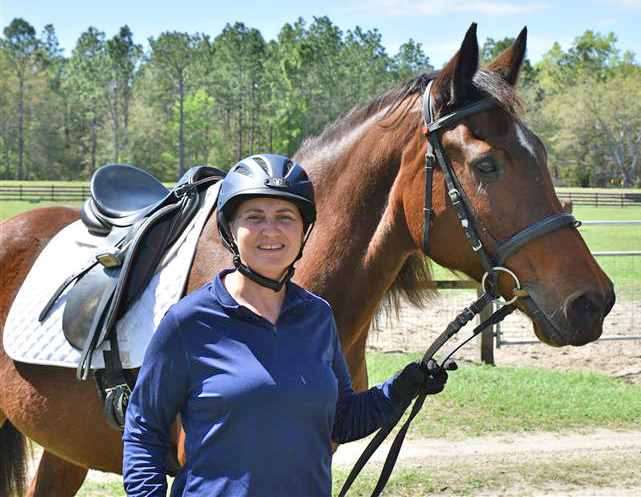
Stephanie Ruff has spent her entire career in various facets of the equine industry. She was a freelance writer for many years, was the owner/editor of Arabian Finish Line, managing editor of Arabian Horse Life and content manager of Practical Horseman and Dressage Today before moving to The Horse. She has ridden many different disciplines, but for the last 20 years has focused on dressage. Stephanie has both a B.S. and M.S. in Animal Science from the University of Kentucky and has always had a keen interest in equine health, science, and research. A native of Pennsylvania, Stephanie enjoys hanging out with her Arabian and Half-Arabian mares, two German Shorthair Pointers, traveling and embracing the Florida lifestyle where she currently lives.

Articles by: Stephanie Ruff

Trailer Resistance

I’ve had my yearling filly all of her life. I trained her from week one to trailer load, and she was fine with getting in and out. However, this was with a four-horse slant load trailer that steps up. Now I need to load her into a two-horse trailer with a ramp and a divider. When I tried to load her into the two-horse trailer, she would not load and tried many evasive tactics (rearing,

Read More

Vaccinations: Kick-Starting the Immune System

These days, research protocols are a little more sophisticated and complicated, although the basic premise for testing a vaccine is pretty much the same: The researcher vaccinates the animal against the infection or disease using some sort of disease component originally isolated from affected animals and, by one means or another, determines whether the vaccine is safe and effective.

Read More

Farm Equipment: Nice or Necessary?

Proper equipment will help you manage your barn efficiently and safely, but there is a big difference when it comes to equipment you need versus equipment that’s just nice to have.

Read More

Ohio EHV-1 Outbreak; Strain Might Be Atypical

The worst is over in an equine herpesvirus type 1 (EHV-1) outbreak that thus far has caused the death of 12
horses, and scientists are still studying the virus to see if it is somehow different from the normal EHV-1 strain. The outbreak, which began Jan. 12, quarantined the entire equine population of 138 horses at the University of Findlay’s English riding facility in Findlay, Ohio. It

Read More

Emerging Disease in Foals

A bacteria that causes weight loss, colic, diarrhea, and hypoproteinemia (abnormally low protein in the blood) in foals is being seen more often in North America and Europe. The affected foals are usually four to eight months old, but can be older. While the causative bacteria Lawsonia intracellularis can cause severe disease, it is very treatable if caught early.

Lawsonia

Read More

Medication Rules Revised

The USA Equestrian (USAE) Board of Directors approved a rule change on Jan. 19 that should reduce the incidence of corticosteroid abuse in equine athletes. The USAE sets rules for 27 breeds and disciplines competing in the United States, and is the U.S. equestrian national governing body. The corticosteroid rule will go into effect Dec. 1, 2003.

The USAE’s Veterinary and Equine Drugs and

Read More

West Nile Virus Found In Aborted Kentucky Fetuses

Evidence of West Nile virus (WNV) was found in 35 aborted fetuses in Kentucky since July of 2002, according to Lenn Harrison, VMD, head of the Kentucky Livestock Disease Diagnostic Center in Lexington. “We have handled about 400 aborted fetuses and tested them, so this is less than 10%,” he reported on Feb. 4. He emphasized that WNV has not been known to cause abortion in mares; therefore,

Read More

New Treatment for Endotoxemia

Michelle Henry Barton, DVM, PhD, of the University of Georgia, recently completed a project on treating endotoxemia with polymyxin B (PMB), an alternative to endotoxin antibody products. The drug PMB kills many Gram-negative bacteria and also binds endotoxin, preventing interaction of endotoxin with white blood cells (WBC) as do endotoxin antibody products–thus heading off the damaging

Read More

More Pigeon Fever in Kentucky

The bacterial disease “pigeon fever,” also known as dryland distemper, usually is seen west of the Mississippi–especially in California and southwestern states–but it has been recognized in Kentucky and Florida in increasing numbers in recent years. There was a small outbreak in Kentucky in November 2002 (see article #4040 at www.TheHorse.com). Some

Read More

Lower Limb Research at the Bluegrass Laminitis Symposium

Probably the foremost biomechanics researcher in the country, Hilary Clayton, BVMS, PhD, MRCVS, McPhail Dressage Chair in Equine Sports Medicine at Michigan State University’s McPhail Equine Performance Center, discussed recent lower limb research during the 16th annual Bluegrass Laminitis Symposium. Some of the studies she described were performed in collaboration with researchers at

Read More

Marbles Keep Mares Out of Heat

Mares in performance careers are sometimes a frustration to their trainers and riders because during estrus, they can have difficulty concentrating on their work or have “behavioral problems.” Many horse owners resort to hormone therapy to keep mares from coming into heat while training or showing. The most commonly used drug is a synthetic progestin (altrenogest, marketed as Regumate) given

Read More

Blood Test for Ovarian Tumors

Granulosa-theca cell tumors (GTCTs) are usually tentatively diagnosed by rectal palpation and ultrasound examination after an owner complains of poor performance or aggressive, sexual, stallion-like behaviors. However, the diagnosis can’t be confirmed unless an exploratory laparotomy is performed and the tumor is biopsied (or removed and sectioned for histopathology). These tumors tend to mak

Read More

Lasers for Removing Skin Masses

Skin masses in horses have historically been removed by surgical excision (cutting them out). Regardless of the type of mass, the surgeon’s goal is to remove all of the tissue, limit hemorrhage, and prevent infection while achieving the best possible cosmetic outcome. Equine surgeons at Purdue University have been using a carbon dioxide (CO2) laser in place of a scalpel blade to

Read More

Treating Shoulder Lameness

There is an uncommon type of shoulder lameness in horses that produces a dropped elbow and flexing of the carpus (knee) and pastern at rest. At work, affected horses are typically severely lame with a significantly decreased forward phase of the stride. Radiographs of the shoulder in these cases usually reveal a combination of biceps tendonitis, bursitis, and inflammation of the bone

Read More

When Your Horse’s Muscles Ache

Equine muscle injuries are often elusive, leading to frustration for the rider and a challenging diagnosis for the veterinarian. Since muscle injury can accompany and/or mimic skeletal problems, tendon or ligament injury, or neurological disease,

Read More

More From The Horse

sweaty horse rolling
When is an Older Horse Ready for Senior Feed?
1--Pharnygeal-Wash_StranglesFeature_CourtesyEliseKahn
cutting horse

Stay on top of the most recent Horse Health news with

FREE weekly newsletters from TheHorse.com

Sponsored Content

Weekly Poll

sponsored by:

How do you plan to keep your horse safe during fireworks and Fourth of July festivities? Please select all that apply.
109 votes · 138 answers

Readers’ Most Popular

The Horse
Privacy Overview

This website uses cookies so that we can provide you with the best user experience possible. Cookie information is stored in your browser and performs functions such as recognising you when you return to our website and helping our team to understand which sections of the website you find most interesting and useful.