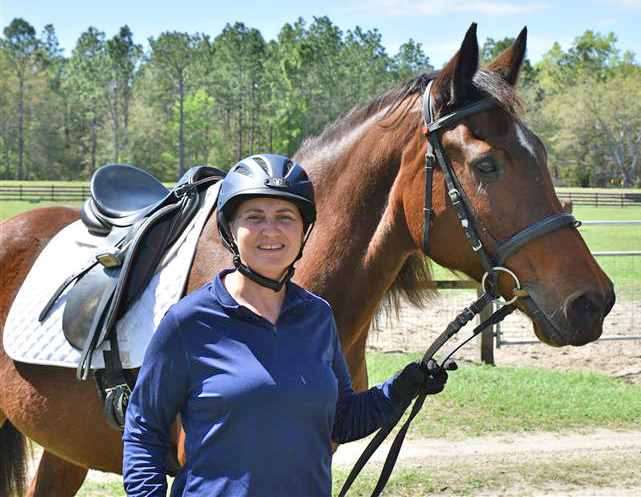
Stephanie Ruff has spent her entire career in various facets of the equine industry. She was a freelance writer for many years, was the owner/editor of Arabian Finish Line, managing editor of Arabian Horse Life and content manager of Practical Horseman and Dressage Today before moving to The Horse. She has ridden many different disciplines, but for the last 20 years has focused on dressage.
Stephanie has both a B.S. and M.S. in Animal Science from the University of Kentucky and has always had a keen interest in equine health, science, and research.
A native of Pennsylvania, Stephanie enjoys hanging out with her Arabian and Half-Arabian mares, two German Shorthair Pointers, traveling and embracing the Florida lifestyle where she currently lives.
Equine chiropractic is a complementary modality that can be used in veterinary medicine for the diagnosis, treatment, and potential prevention of select musculoskeletal disorders in horses.
While only a small percentage of you are involved in the industries that have legalized gambling, many of you live in states with legalized racing, and all of you benefit from those industries. A tremendous number of the research projects from around the world that have shed new light on diseases and injuries have been funded by horse racing dollars from tracks and simulcast facilities.
The American Association of Equine Practitioners (AAEP) is the leading provider of continuing education for veterinarians who deal with horses. The association is also committed to educating horse owners, and that commitment is growing as evidenced by the development of an Owner Education Committee and plans for assisting veterinarians in educating their clients through electronic and print
Stephanie L. Church, Editorial Director
March 1, 2003
Antimicrobial drugs in veterinary medicine have made a dramatic improvement in the health of our horses, but it’s alarming when infections do not respond to these drugs. “It is not a new phenomenon, but there has been ever-growing concern about antimicrobial resistance.”
Stephanie L. Church, Editorial Director
March 1, 2003
Fitch said that he often handles problem horses by himself, as a handler might not anticipate the interaction between him and the horse and can end up in the way or injured. Also, it’s important to have a place where the horse can move around in case of a panic–for that reason, Fitch doesn’t like treating horses in cross ties.
I think we need to change the way we think about a lot of dental problems. The abnormal wear often is not the problem–the long tooth is often the healthiest tooth with nothing keeping it from erupting correctly. If we straighten out (shorten) this tooth, we completely ignore what the pathology is (in the other teeth).
Stephanie L. Church, Editorial Director
March 1, 2003
Saville presented a summary of what is known about EPM, and he believes that with better understanding of the disease, wildlife management, risk-factor manipulation, prophylactic medications, and possible vaccination, that prevention of EPM can be attained.
There were many more presentations and discussions at this year’s AAEP Convention than could be contained in these pages. Other articles from the convention can be found online at www.TheHorse.com/AAEP2002. Below are some of the articles that can be found on the site.
Comparison of Three Holding Solutions for Cooled Storage of Equine
Horseman’s Day, held for the third time as part of the annual AAEP convention, was another rousing success. Helping stimulate the interest and enthusiasm was the quality of the speakers. They couched their talks in terms the average horse owner could understand, but they certainly didn’t talk down to them. It was the right mixture of scientific terminology and backyard talk to get the message
The Milne Lecture is also known as the State of the Art Lecture because each year’s topic is selected for its groundbreaking qualities and potential to change the paradigms by which veterinarians and researchers understand that topic. This year’s Milne Lecture (which is named after Frank J. Milne, an AAEP
With West Nile virus (WNV) marching across the United States and affecting both horses and humans, infectious disease prevention has been a hot topic in barns, the media, veterinary clinics, and elsewhere. During the Infectious Disease Forum, moderated by Josie Traub-Dargatz, DVM, MS, Dipl. ACVIM, professor of equine medicine
Botulism in foals less than six months of age is readily treated, with a survival rate of more than 95% in appropriately treated foals. Treatment can include nursing care, intravenous fluid support, nasogastric or nasoesophageal tube feeding, broad-spectrum antimicrobials, oxygen therapy, and the administration of botulism antitoxin.
Peripheral Cushing’s syndrome (PCS) is a recently named problem seen in middle-aged horses and ponies with obesity-associated laminitis. These horses tend to accumulate fat in the crest of the neck, over the rump, and in the sheath of males. It was first proposed that classic Cushing’s disease–a pituitary gland disorder that leads to excessive cortisol levels in the blood–was causing the
The reproduction session was something of an A to Z seminar. It started with discussions on endometrial echotexture (ultrasound results) and using computer analysis to determine when a mare will ovulate, or has ovulated, and along the way included a French researcher describing how to turn an unbred mare which has previously given birth into a nurse mare capable of producing enough milk to
Many of us have seen the daring and exciting rescues of horses shown on television–such as rescuing a horse hanging from a bridge, or one trapped in a river. Then there’s the famous scene of a horse being rescued by helicopter. However, many of these rescues cause further injury or death of the horse.