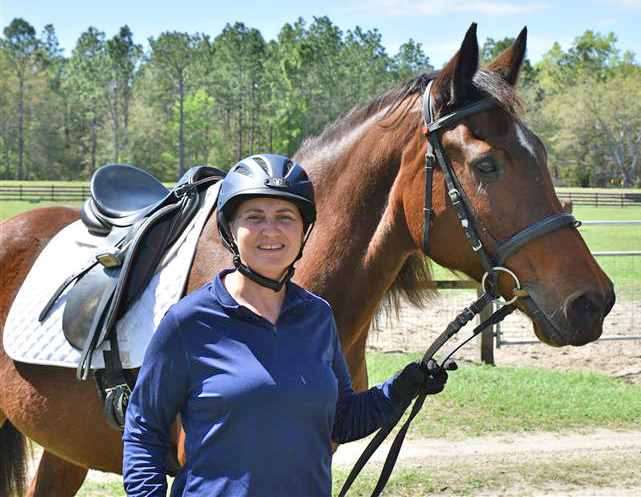
Stephanie Ruff

Stephanie Ruff has spent her entire career in various facets of the equine industry. She was a freelance writer for many years, was the owner/editor of Arabian Finish Line, managing editor of Arabian Horse Life and content manager of Practical Horseman and Dressage Today before moving to The Horse. She has ridden many different disciplines, but for the last 20 years has focused on dressage. Stephanie has both a B.S. and M.S. in Animal Science from the University of Kentucky and has always had a keen interest in equine health, science, and research. A native of Pennsylvania, Stephanie enjoys hanging out with her Arabian and Half-Arabian mares, two German Shorthair Pointers, traveling and embracing the Florida lifestyle where she currently lives.

Articles by: Stephanie Ruff

AAEP 2002: A Review of Equine Zoonotic Diseases: Risks in Veterinary Medicine

Zoonotic diseases are those that can be passed from animals to humans, and, noted Scott Weese, DVM, DVSc, Dipl. ACVIM, of the Department of Clinical Studies at the University of Guelph, they are an ever-present threat to veterinarians. “A number of zoonotic agents may be encountered in veterinary practice and the severity of human disease can range from mild to fatal,” he said. “Prompt
Read More

Learned Vets

The American Association of Equine Practitioners (AAEP) is the leading provider of continuing education for veterinarians who deal with horses. The association is also committed to educating horse owners, and that commitment is growing as evidenced by the development of an Owner Education Committee and plans for assisting veterinarians in educating their clients through electronic and print

Read More

Mules and Donkeys

In addition to long ears, she said, donkeys have a short, upright mane and have finer, lighter hair around the eyes and muzzle when compared to horses. Donkeys have no forelock and have a switch for a tail. Mules normally will have a full tail, but might not have a forelock.

Read More

AAEP 2002: Vitex Agnus Castus Extract for Treatment of Equine Cushing’s Syndrome

Vitex agnus castus extract (Chaste Berry) has been reputed to have therapeutic efficacy in the treatment of Equine Cushing’s syndrome. However, results of a study at the University of Pennsylvania’s New Bolton Center repudiated these claims.  Jill Beech, VMD, professor of medicine in the School of Veterinary Medicine and chief of the section of large animal medicine at the New Bolton

Read More

AAEP 2002: Prevention and Control of Pneumonia Caused by Rhodococcus equi

Pneumonia caused by the bacteria Rhodococcus equi is an often-fatal disease that can be difficult to eradicate from affected farms. “The impact of this disease can be large because prevalence and case-fatality rates are often high; treatment is prolonged, expensive, associated with adverse effects, and not uniformly successful; the disease may diminish future performance; and farms

Read More

Horse Council to Focus on Education, Advocacy

The American Horse Council Convention and Congressional Conference for 2003 will focus on education and how it can lead to advocacy.

The convention, set for April 5-8 in Washington, D.C., will feature state horse council meetings, panel discussions on a variety of topics, an awards luncheon, and a Congressional dinner. It will end with a Congressional breakfast that will give participants a

Read More

Equine Heart Murmurs (AAEP 2002)

Despite the high incidence of murmurs in racehorses, they are very hard to diagnose. Heart murmurs are usually low-frequency sounds at the lower limit of human hearing which are difficult for the human voice to reproduce accurately.

Read More

Extracorporeal Shock Wave Therapy (AAEP 2002)

Scott McClure, DVM, PhD, of Iowa State, reported on the effects of extracorporeal shock wave therapy (ESWT) on suspensory ligament desmitis. He noted that ESWT is being used for the treatment of equine musculoskeletal diseases.

Read More

Ice, Snow, Cold Hit Horse Country Hard

From Kentucky up through New York, the recent winter storm’s ice and snow has caused major problems for horse owners and those in the horse business. In Kentucky, an inch or more of ice coated every surface starting Feb. 16, causing power lines to sag onto roads and fields, trees to split and drop limbs, and streets to become impassible. There was flooding in other parts of the state.

Read More

Federal Funds to Support Animal Health and Disease Research

According to an Associated Press story on bloodhorse.com, The University of Kentucky (UK) will receive $11.36 million in funding in the current federal budget, U.S. Sen. Mitch McConnell said Monday. Some of the funds will be spent on research into animal health and diseases, such as mare reproductive loss syndrome (MRLS).

Of the

Read More

Horses At Risk For Ulcers

Horses moving faster than a walk could be at greater risk of developing gastric ulcers. Alfred Merritt, DVM, MS, and Mireia Lorenzo-Figueras, DVM, recently discovered that changes in gastric tension during intense exercise can push acidic stomach contents up into the vulnerable, squamous-cell-lined portion of the stomach–a circumstance that hints at why ulcers often develop or worsen when

Read More

Sallee On the Road, Barely

Robert Maxwell, owner of Sallee Van company in Lexington, said generators are keeping the phones, lights, and a little heat on in the office, but downed trees are keeping larger trucks in the parking lot.

“We can’t get the big trucks off the lot because of trees down everywhere around the office, said Maxwell, but we have some of the smaller vans out. We’re parking them at the Ryder

Read More

Ice Storm Disrupts Veterinary Services in Kentucky

Despite the disaster of ice, snow, and cold weather, all three of the major veterinary clinics in Central Kentucky are up and running, although Hagyard-Davidson-McGee is on emergency power. Dr. Doug Byars, head of the medicine clinic at Hagyard-Davidson-McGee in Lexington, said generators are keeping services going for the horses, but surgery is on an emergency basis for the moment.

Read More

AAEP 2002: OIE Flu Surveillance

“Diseases like flu and herpesvirus are always going to be problems for horse owners, and they are not going away,” said Tom Chambers, PhD, of the University of Kentucky’s Gluck Equine Research Center. “The secret to effective vaccines for flu is effective surveillance.” This surveillance allows researchers and vaccine manufacturers to stay abreast of which strains are causing

Read More

“Fact Book” Details Effects of MRLS in Kentucky, Other Industry Numbers

The number of mares bred in Kentucky in 2002–the year after mare reproductive loss syndrome first hit–fell by 3.4% from 2001, but the state’s broodmare population remains 33% higher than it was a decade earlier, according to figures released by The Jockey Club and contained in its annual “Fact Book” available online at jockeyclub.com

Mare reproductive loss syndrome reduced the 2001

Read More

Legislation Reintroduced to Ban Horse Slaughter

U.S. Representative John Sweeney (R-NY), chairman of the Congressional Horse Caucus, and U.S.Representative John Spratt (D-SC) reintroduced the American Horse Slaughter Prevention Act on Thursday. The bill would ban the trade in horsemeat and live horses for human consumption.An identical version of this bill will soon be introduced in the Senate.

This is a developing story, pleas

Read More

More From The Horse

sweaty horse rolling
When is an Older Horse Ready for Senior Feed?
1--Pharnygeal-Wash_StranglesFeature_CourtesyEliseKahn
cutting horse

Stay on top of the most recent Horse Health news with

FREE weekly newsletters from TheHorse.com

Sponsored Content

Weekly Poll

sponsored by:

How do you plan to keep your horse safe during fireworks and Fourth of July festivities? Please select all that apply.
107 votes · 134 answers

Readers’ Most Popular

The Horse
Privacy Overview

This website uses cookies so that we can provide you with the best user experience possible. Cookie information is stored in your browser and performs functions such as recognising you when you return to our website and helping our team to understand which sections of the website you find most interesting and useful.