Stephanie Ruff

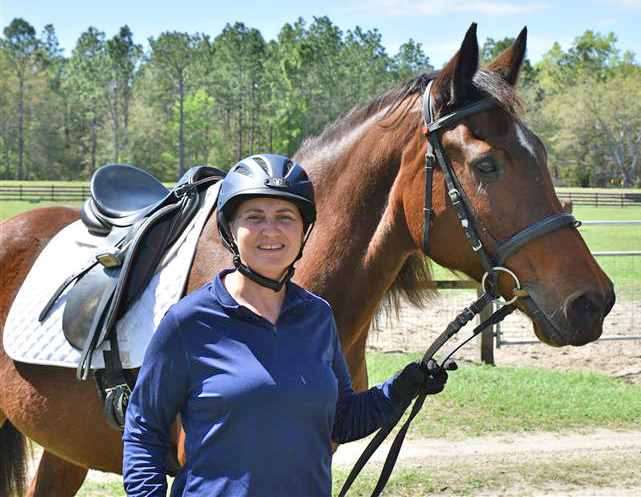
Stephanie Ruff has spent her entire career in various facets of the equine industry. She was a freelance writer for many years, was the owner/editor of Arabian Finish Line, managing editor of Arabian Horse Life and content manager of Practical Horseman and Dressage Today before moving to The Horse. She has ridden many different disciplines, but for the last 20 years has focused on dressage. Stephanie has both a B.S. and M.S. in Animal Science from the University of Kentucky and has always had a keen interest in equine health, science, and research. A native of Pennsylvania, Stephanie enjoys hanging out with her Arabian and Half-Arabian mares, two German Shorthair Pointers, traveling and embracing the Florida lifestyle where she currently lives.

Articles by: Stephanie Ruff

AAEP Convention: Respiratory Problems

INFLUENZA


“Diseases like flu and herpesvirus are always going to be problems for horse owners, and they are not going away,” said Tom Chambers, PhD, of the University of Kentucky’s Gluck Equine Research Center. “The secret to effective vaccines for flu is effective surveillance,” which allows researchers and vaccine manufactures to stay abreast of

Read More

When Your Horse’s Muscles Ache

Equine muscle injuries are often elusive, leading to frustration for the rider and a challenging diagnosis for the veterinarian. Since muscle injury can accompany and/or mimic skeletal problems, tendon or ligament injury, or neurological disease,

Read More

Ohio State University Veterinary Hospital Management of Horses from University of Findlay EHV-1 Outbreak

Admission: Six horses were referred from the University of Findlay for emergency treatment. All horses had signs of neurological disease. One horse was dead on arrival on 19 January 03; this horse went directly to necropsy and was never admitted to the Hospital. Four horses were admitted 18-19 Jan 03. One horse was admitted 28 January 03. All horses were segregated in the old part of

Read More

Equine Herpesvirus 1: Pathophysiology and Commonly Asked Questions

The following information was posted on The Ohio State University Veterinary Teaching Hospital’s web site Feb. 26. The author, Catherine W. Kohn, VMD, Dipl. ACVIM, is professor of equine medicine and surgery at OSU.

Typical Clinical Signs of EHV-1 Infection
 
Upper respiratory infection is the most common manifestation of EHV-1 infection. Commonly

Read More

AAEP Convention: Milne Lecture–Bucked Shins

The Milne Lecture at the American Association of Equine Practitioners (AAEP) Convention is also known as the State of the Art Lecture because each Milne Lecture, regardless of topic, is selected for its groundbreaking qualities and potential to change the paradigms by which veterinarians and researchers understand that topic in the horse. This year’s Milne Lecture (which is named for Frank J.

Read More

Bone and Fracture Treatment in Horses

Bone does not heal, incorporating the scar tissue as seen in most all other tissues–it regenerates itself. It changes its shape and structure based on its use, and if broken can resume 100% of its former strength and function.

Read More

Possible Equine Herpesvirus Type 1 Cases in Iowa

At least two Iowa horses have been euthanized after battling what officials believe might be the neurologic form of equine herpesvirus type 1 (EHV-1). According to Iowa State Veterinarian John Schiltz, DVM, officials know of only one premise possibly affected by the virus, where these two horses lived. “Some of the preliminary tests have come back negative, but the definitive testing is

Read More

Colorado State Researchers Developing New Test for Strangles

Equine researchers at Colorado State University’s James L. Voss Veterinary Teaching Hospital are developing a faster and simpler test to determine a horse’s exposure level to strangles. Currently, tests exist only for horses with active signs of disease.

The test method is an enzyme-linked immunosorbant assay (ELISA) test, which would provide veterinarians with a tool to quickly

Read More

Equine Herpes Virus Type 1 Cases at Pennsylvania Racetrack Keeping Officials Cautious

A restriction on horses shipping between Philadelphia Park Racetrack and Penn National Race Course due to three horses testing positive for equine herpesvirus type 1 (EHV-1) at Penn National might be lifted early next week, officials for both Pennsylvania racetracks said Wednesday.

“Although three horses from trainer Bob Wolfe did test positive, we had some good news

Read More

West Nile Virus Found in Overwintering Mosquito in Pennsylvania

Pennsylvania Department of Environmental Protection and Lehigh County West Nile virus (WNV) personnel detected WNV in a Catasaqua Borough mosquito pool.

The West Nile virus workers were collecting samples to determine the status of the virus in overwintering mosquitoes. Officials emphasized that this species of mosquito, Culex pipiens, is not active this time of year, and poses no

Read More

New Jersey Horse Recovers from Frozen Pond

A 2,000-pound Belgian gelding named Janyck (pronounced Yanick) has nearly recovered after a dramatic rescue from a frozen pond on Feb. 13. The 18-hand, 7-year-old’s misadventure took place in Woolwich Township, N.J. The rescue effort included the local fire department, neighbors, owner Alison Gieschen, Ernie Beier, DMV, and numerous volunteers.

Beier said, “It took two tow trucks and

Read More

AAEP Convention: Fractures of the Distal Phalanx

Fractures of the distal phalanx (also known as P3 or the coffin bone) are common, especially in racehorses, noted Tara S. Rabuffo, DVM, of the University of Pennsylvania’s New Bolton Center. She and her colleagues reviewed case records and all related diagnostic materials on 73 racehorses (26 Thoroughbred and 47 Standardbred during an 11-year period) admitted to the George D. Widener Hospital

Read More

Gastroduodenoscopy: What to Expect

Veterinarians have a variety of ways to look inside your horse to see what might be bothering him. One of these methods is gastroduodenoscopy, which allows the veterinarian to see the interior of the esophagus, stomach, and duodenum with the use of a gastroscope.

Read More

West Nile Virus Vaccine Receives Full Licensure

The USDA has issued a full license to Fort Dodge Animal Health for its West Nile virus (WNV) vaccine that has been distributed under a conditional license since August of 2001. Results of efficacy studies completed and submitted to the USDA qualified the vaccine for full licensure. According to Tom Overbay, DVM, director, Field Veterinary Services at Fort Dodge, 95% of horses vaccinated with

Read More

Localized Equine Herpesvirus Detected at Penn National Racecourse

A small outbreak of equine herpes at Penn National Racecourse has prompted management of Philadelphia Park to bar horses shipping in to race as well as horses shipping out to “race and return” from the Grantville, Pa. oval.

Richard Schnaars, general manager of Penn National, stressed that the situation is “very localized,” with only two horses from the stable of trainer Bob Wolfe

Read More

AAEP 2002: Infectious Diseases Subdued, Not Eradicated

In discussing anthrax, screwworms, and piroplasmosis, Irby said that the three disease are related in that each “can affect equids, has the potential to devastate domestic livestock, is present in many foreign countries, and may first be detected by veterinarians in private practice.”

Irby re-iterated that it is imperative that private practice veterinarians realize tha

Read More

More From The Horse

sweaty horse rolling
When is an Older Horse Ready for Senior Feed?
1--Pharnygeal-Wash_StranglesFeature_CourtesyEliseKahn
cutting horse

Stay on top of the most recent Horse Health news with

FREE weekly newsletters from TheHorse.com

Sponsored Content

Weekly Poll

sponsored by:

How do you plan to keep your horse safe during fireworks and Fourth of July festivities? Please select all that apply.
108 votes · 137 answers

Readers’ Most Popular

The Horse
Privacy Overview

This website uses cookies so that we can provide you with the best user experience possible. Cookie information is stored in your browser and performs functions such as recognising you when you return to our website and helping our team to understand which sections of the website you find most interesting and useful.