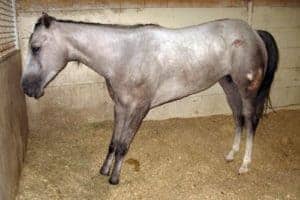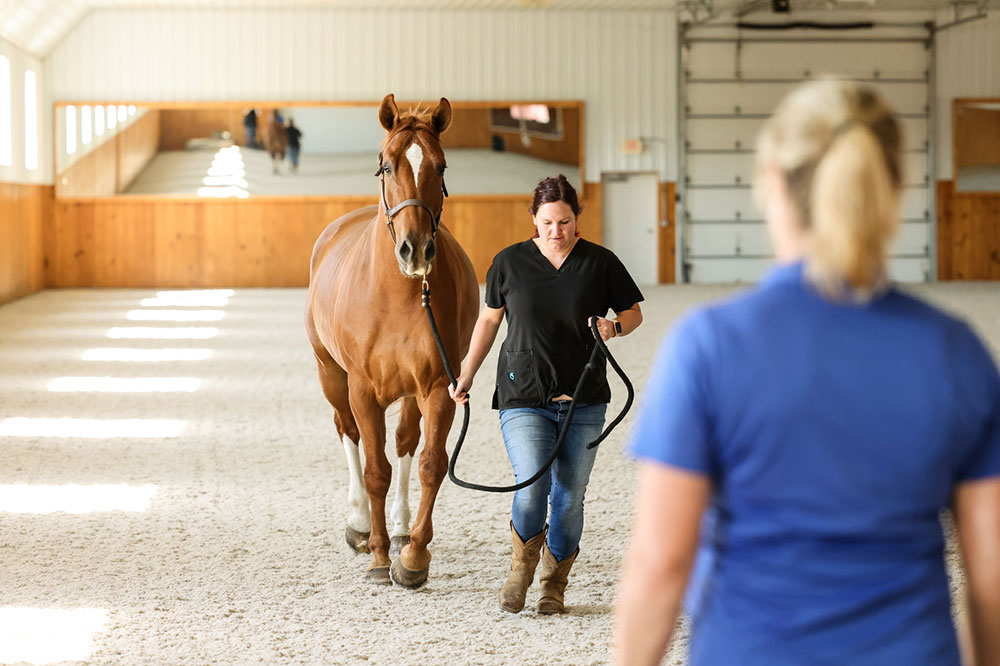
Historically, veterinarians have gauged rehabilitation success by watching a horse’s gait and behavior. However, interobserver variability often undermines the reliability of these assessments.
Over the past decade the equine rehabilitation landscape has undergone a significant transformation, driven by the integration of objective monitoring technologies. Immobile, lab-based tools have now been replaced with more practical, field-ready equipment.
These tools can support practitioner decision-making and facilitate the development of individualized recovery protocols.
The Shift Toward Objective Measurement in Equine Rehab
“Objective tools allow us to track changes in gait and performance over time, which is invaluable for assessing progress during rehabilitation,” says Vicki Walker, DPhil, MSc, FHEA, senior lecturer in the equine department at Hartpury University, in Gloucester, U.K. “Establishing a baseline when the horse is sound and healthy also makes it easier to identify early deviations that might indicate a developing problem.”
These data complement the clinical observations of the horse’s support team, providing evidence-based context for decision making, she says.
Force and Pressure Plate Systems in Equine Rehab
“While force plates remain the gold standard for objective kinetic assessment, providing high-resolution, three-dimensional data on ground reaction forces (GRFs), they are not very practical for day-to-day use, which is why portable, easy-to-use systems are becoming increasingly popular in rehabilitation and training settings,” says Walker. Recent developments include portable, wireless force platforms and pressure mats that facilitate field use without sacrificing data quality.
Technological innovations such as the instrumented horse boot (a smart hoof boot embedded with GRF sensors) or training-monitoring apps (which might also include wearable sensors) can record stride length, limb loading, stride regularity, time spent in each gait, time spent going each direction, and even heart rate, Walker says. These technologies help objectively quantify weight-bearing improvements and postural stability, which are critical parameters in rehabilitation. For example, veterinarians might use the smart hoof boot to determine if a horse with an injury is placing equal weight on all limbs or if he is favoring the injured limb, even if slightly. This information can help them determine when the horse is ready to progress in the rehabilitation process.
Inertial Measurement Units in Equine Rehabilitation Programs
Inertial measurement units (IMUs) have emerged as a pivotal tool for field-based gait analysis. These lightweight wearable sensors—typically placed on the horse’s poll, withers, limbs, or trunk—capture acceleration and angular velocity data in real time. Researchers on recent studies have validated these sensors’ accuracy in measuring horses’ stride symmetry, phase durations (how long the horse spends in each portion of one stride), and vertical displacement (how much the body rises and fall with each step), with performance comparable to that of lab-based force plate systems, which can help veterinarians objectively quantify a horse’s soundness.1
Equine Video Gait Analysis and AI-Based Detection
With the help of artificial intelligence (AI), computer vision systems can analyze a horse’s gait from video without using markers, a process called pose estimation. These systems detect anatomical landmarks and compute stride parameters automatically. Researchers on comparative studies have shown that AI-based video analysis aligns closely with IMU outputs and, in some cases, demonstrates greater sensitivity in detecting gait asymmetry.2 Still, reliance on technology should not replace careful observation of the horse’s behavior and clinical signs, says Walker.
Multimodal Integration and Predictive Analytics
Building on this, recent research supports integrating multiple monitoring modalities in addition to clinical observation to capture a holistic view of the horse’s recovery. Systems that combine IMUs, force data, heart-rate monitoring, and AI analytics generate comprehensive profiles of a horse’s locomotor and physiological status.
Machine learning algorithms can identify movement anomalies, classify exercise intensity, and track deviations from normative baselines.3 These capabilities support real-time decision making and allow veterinarians and owners to adjust a horse’s rehabilitation program dynamically based on objective progress metrics.
“Many of the more advanced systems are designed for professional use, but a growing number of apps and consumer-friendly tools are available to riders, trainers, and owners,” says Walker. “These can be used to monitor session details such as duration, time spent on each rein (going each direction), gait distribution (how much time spent at each gait), and heart rate.”
These systems can ensure horses receive consistent care and exercise across handlers during rehabilitation with less variation. They help guide decisions but always in the context of veterinary and professional assessment, she adds.
Limitations of Technology in Equine Rehab Programs
“Despite their potential, these technologies are not without limitations,” says Walker. Not all commercial systems have been validated against gold-standard methods, she explains. Also, if a tool is not sensitive enough to detect small but meaningful changes, users might draw misleading conclusions.
Therefore, veterinarians still play a critical role in interpreting the data because, for example, sensitive systems can flag minor gait asymmetries that might not be clinically relevant for every horse.
“These systems are best seen as one piece of the overall rehabilitation puzzle; they are helpful for guiding decisions, but always in the context of veterinary and professional assessment,” says Walker.
Take-Home Message
Objective tracking technologies give veterinarians new ways to measure equine rehabilitation and provide a clearer picture of recovery. Inertial measurement units, portable force plates, AI-based gait video analysis, and integrated analytics platforms can enhance the precision and efficacy of equine rehabilitation programs.
These technologies, when appropriately validated and interpreted within a clinical context by professionals, can enable earlier interventions and safer return-to-work decisions for equine athletes.
References
- Blake R, Marlin D. From Biomechanics to Welfare: Integrative Advances in Equine Sports Medicine and Rehabilitation. Animals. 2025;15(18):2706.
- Fercher C, Bartsch J, Kluge S, et al. Applying Multi-Purpose Commercial Inertial Sensors for Monitoring Equine Locomotion in Equestrian Training. Sensors. 2024;24(24):8170.
- Calle-González N, Lo Feudo CM, Ferrucci F, et al. Objective Assessment of Equine Locomotor Symmetry Using an Inertial Sensor System and Artificial Intelligence: A Comparative Study. Animals. 2024;14(6):921.