An increase in body temperature can have several causes; fever due to infection is one of them.
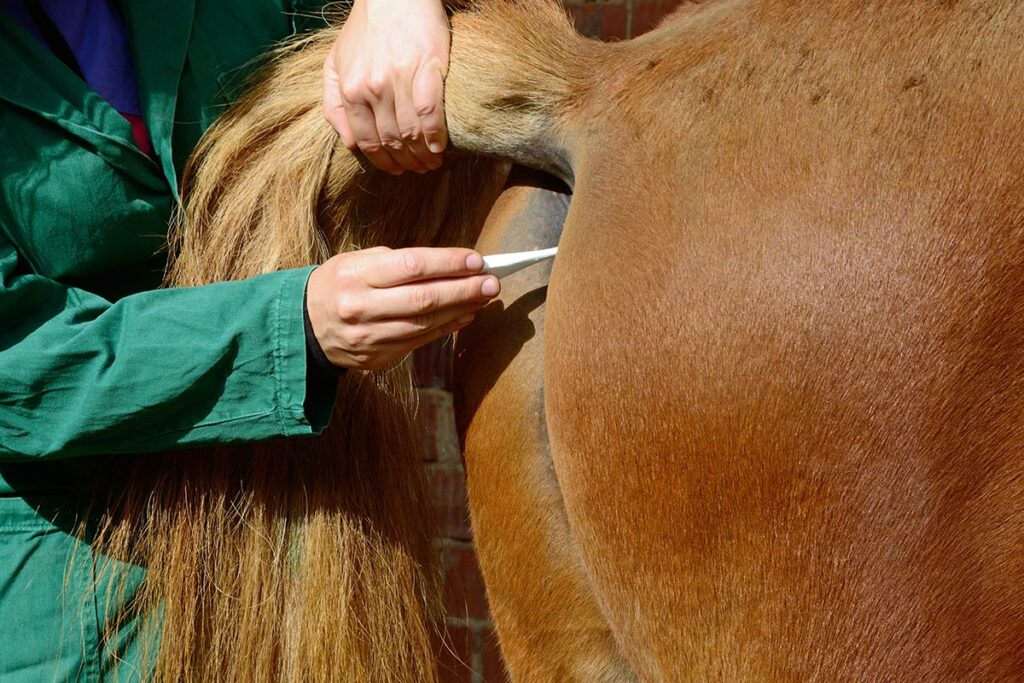
During infection, inflammation-associated mediators are produced, which can shift the brain’s set point, leading to an increase in body, or core, temperature. In horses, we can measure increases in body temperature using a rectal thermometer. Reliable alternatives are subcutaneously placed “thermal chips” that are measured with a reader, or nasogastric tube “smart pills” for continuous core temperature recording over time. However, nothing beats the rectal thermometer for its simplicity, availability and cost.
Digital thermometers have widely replaced mercury thermometers. Digital thermometers come in various types and brands and are both reasonably priced and affordable. Individual baseline (rectal) temperatures can differ between horse breeds and by age. Rectal temperatures in the same horse can fluctuate, typically by less than a degree with season or ambient temperature, and by 1, up to 2, degrees during the day. Naturally, measured temperatures are higher post-exercise than at rest. For horses, a cut-off for fever of a per rectum measured temperature is conservatively set at 101.5°F (or 38.6°C).
Not all horse owners know how to take temperatures, nor are thermometers always available. However, taking temperatures is one of the first steps if a horse appears listless, too quiet or anorexic. After the (Equid) (alpha)herpesvirus (EHV-1) Myeloencephalopathy outbreak at show grounds in Valencia, Spain, in 2021, daily taking temperatures (and reporting) became a mandatory task for participating parties. Requested by FEI during transportation to an event, at entry, but also during competitions, made this simple task an important early alert mechanism to prevent or mitigate disease outbreaks at competitions.
Recording changes in core temperatures in horses has been an intricate part of any clinical study. Our laboratory at the University of Kentucky recently concluded a live horse study with twice daily body temperature recordings. We used digital thermometers for this part of the daily clinical exams. The thermometers we used were different brands of over-the-counter thermometers. Before their use, all thermometers were calibrated in the laboratory using a water-bath test at two preset temperatures: 37.0°C (98.6°F) and 39.2°C (102.6°F).
Part of this assessment is repeatability, where three consecutive readings performed in the in vitro experimental setup yielded very similar results. During our experiment, we followed a strict protocol of three consecutive readings while the thermometer remained inserted in the rectum of a horse. To our great surprise, the third reading was consistently the highest of the three. Differences between the first and third measurements became wider during the fever days of individual horses.
Furthermore, several of our horses are fitted with a thermal chip, and we were able to compare its readings with those from the thermometer. Our third measurement correlated best with the thermal chip reading.
Conclusions
Knowing a horse’s body temperature is vital for its clinical assessment. While digital thermometer readings are typically easy to obtain, easy to read and have replaced mercury and glass thermometers in equine environments completely, they may need a more stringent “three-times-is-the-charm” approach than we previously thought.
We advise anyone taking rectal temperatures in horses with digital thermometers to repeat the measurement at least once with the thermometer still inserted in the rectum. If results diverge between the first and second measurements, a third measurement is indicated.
This is an excerpt from Equine Disease Quarterly, Vol. 35, Issue 2, funded by underwriters at Lloyd’s, London, brokers, and their Kentucky agents. It was written by Lutz S. Goehring, DVM, MS, PhD, Wright–Markey Professor of Equine Infectious Diseases at the University of Kentucky’s Gluck Equine Research Center, in Lexington, and Maria Polo, DVM, PhD graduate student, also at the Gluck Equine Research Center.