Give horses the seemingly safest, most luxurious box stalls in the world, with clean, deep bedding and big windows, and they’ll still be dissatisfied.
Horses, by nature, don’t want to be alone. Even when they appear comfortable with isolation, their welfare can be compromised by prolonged separation from other horses. That’s because horses are “intensely social,” says Andrew McLean, PhD, BSc, Dipl. Ed., founder of the Australian Equine Behaviour Centre, in Victoria.
“They need to not just see each other but actually touch each other and engage in social grooming,” he says. “That really makes a big difference.”
Roly Owers, MRCVS, CEO of World Horse Welfare, in Norfolk, U.K., agrees. “Fifty-five million years of evolution have created an animal with a fundamental need for what we call ‘the three Fs’: friends, freedom, and forage,” he says. “We only domesticated horses a few thousand years ago, and they are still hardwired to need those three Fs.”
Despite the effort, expense, and sometimes necessity of individual housing, even the most elaborate stall setup cannot fully meet a horse’s social needs. Researchers have long linked long-term social isolation to changes in behavior, stress responses, and physical health.
Acute Stress Response to Equine Isolation
When we separate horses from other horses, the autonomic nervous system shifts toward a stress response, says Kelly Yarnell, PhD, principal lecturer in equine health and welfare at Nottingham Trent University, in the U.K. She has documented increases in cortisol (the stress hormone) along with notable behavioral changes in isolated horses.
Their heart rates tend to rise, and normal heart rhythm patterns can become disrupted, says Iwona Janczarek, PhD, of the University of Life Sciences, in Lublin, Poland. Behaviorally, isolated horses often become highly active and pace, whinny, and defecate more frequently.
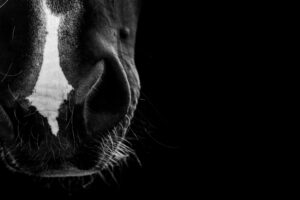
Horses also display recognizable facial indicators of stress, including increased visibility of the whites of the eyes, dilated nostrils, forward-facing ears (as opposed to relaxed ears), and frequent blinking. Together, these signs suggest a high-arousal, negative emotional state, says Johan Lundblad, DVM, a PhD candidate at the Swedish University of Agricultural Sciences, in Uppsala.
Chronic Stress Buildup in Horses
When social isolation continues for months, the effects can become chronic, says Jéssica Carvalho Seabra, PhD, of the Federal University of Paraná, in Curitiba, Brazil, and Colorado State University, in Fort Collins.
In her study of sport horses housed in individual box stalls and exercised daily, Seabra documented stereotypies (repetitive behaviors that appear to have no purpose) such as cribbing, weaving, and stall-walking. She also observed excessive licking, eating bedding and manure, chewing wood, pawing, kicking, headshaking, and other abnormal behaviors. On average, the horses spent nearly four hours each day performing stereotypies or other abnormal behaviors.
Long-term isolation can also increase aggression toward both humans and horses, says Alice Ruet, PhD, of the National Institute for Agricultural Research (INRA) in Nouilly, France. She suggests this aggression could be an outlet for frustration stemming from social deprivation.
Over time, some horses become increasingly withdrawn and unresponsive to their surroundings, entering what researchers describe as a depressionlike state.
“The horse—which has lived in open spaces for the last several millennia with unrestricted access to forage and especially while establishing strong and complex social relationships with other horses—just isn’t made for living alone, isolated in a box, regardless of how well-set-up it is,” says Ruet’s INRA colleague, Léa Lansade, PhD.
McLean adds that this mental withdrawal aligns with what we know about social species. “Human psychology research shows that isolation is one of the most important factors in mental disorders,” he says. “I think we should recognize that it’s possibly the same thing for a horse.”
Chronic stress can also affect physical health. Persistently elevated cortisol levels might suppress immune function, Yarnell explains. “If very high levels of cortisol are present chronically or on a highly repetitive basis, then this can be detrimental for our horses’ health,” she says.
Seabra’s research supports that concern. Her team identified low white blood cell counts and altered leukocyte profiles in some horses that had been housed individually for at least six months.
Improved Sport Horse Welfare Opportunities
Sport horses are often housed separately due to practicality, tradition, and concerns about injury. Even so, our sources emphasize the importance of meeting these horses’ social needs.
In addition to regular contact with other horses, Ruet recommends providing opportunities for free exercise outdoors. “To preserve their welfare, it seems necessary,” she says.
Owers says these practices are entirely compatible with modern equestrian sport. Through its long-standing partnership with the Fédération Equestre Internationale (FEI), World Horse Welfare has seen growing adoption of more horse-centered management practices. “We’re in a transition in the sport world,” he says. “And I think people just need more confidence to be able to make that change.”
At the same time, he notes that horses should be given choices. “Some will want to retreat from the others—and we need to give them that agency to do so,” he explains.
While not every facility can immediately accommodate social turnout, Owers says making even small changes can improve welfare. For example, using an empty arena for group turnout, lowering partitions between stalls, or creating opportunities for horses to interact more freely can all increase social contact.
“You’ve got to think about it over a whole day, over a whole year, over the whole of the horse’s life,” he says. “If you can make a little change during that horse’s other 23 hours, you can make a massive impact that builds up over seven days, and 365 days. People get this idea that it’s a binary choice, but it’s absolutely not.”
Those changes could potentially benefit performance as well. “We have growing anecdotal evidence that providing horses with social interactions has a positive impact on their performance—and especially from a sports perspective, if we can build that evidence base, that points to a wonderful win-win situation,” Owers adds.
Take-Home Message
Social isolation can affect nearly every aspect of a horse’s health and well-being. While some periods of separation might be unavoidable, prolonged isolation does not have to be the norm—even for performance horses. Thoughtful management can provide opportunities for social interaction while still meeting training and performance goals.