Rescue Group Launches Anti-Slaughter Awareness Campaign
A Pennsylvania-based equine rescue organization hopes a billboard advertising campaign will raise awareness of horse slaughter issues, particularly among non-horse owners.
The horse racing industry is continuously working to make the sport safer for all parties involved, and in 2008, the California Horse Racing Board (CHRB) mandated the use of synthetic track in an attempt to reduce the number of catastrophic injuries that took place on California racing surfaces. To see if the switch was a success, Rick Arthur, DVM, the equine medical director of the CHRB,
With many horse owners still struggling to make ends meet in the current economic downturn, the horse industry continues to look for a ways to help with the ongoing unwanted horse problem. With the support of the Unwanted Horse Coalition’s Operation Gelding, the Tacoma Equine Hospital in Tacoma, Wash., is providing a low-cost castration clinic to struggling horse owners in the Puget Sound area.
A new fund has been established at the Colorado State University Veterinary Diagnostic Laboratory (VDL) to help support research related to diagnosing equine dermatology problems. The fund was created in memory of a horse who was euthanized as the result of a minor scrape on his fetlock.
As of Jan. 1, 2011, clenbuterol (Ventipulmin) will no longer be a permitted medication in Equine Canada sanctioned competitions. As a result, horses competing in Equine Canada sanctioned competitions with a positive test result for clenbuterol will be sanctioned as per the Equine Canada penalty tables and drug classification system as a Class III offence. A withdrawal time of at least 72 hours is
Keeneland buyers and consigners should note that the Kentucky Department of Agriculture has waived the requirement for equine piroplasmosis testing for horses entered in Keeneland’s 2011 January horses of all ages sale.
The American Veterinary Medical Association (AVMA) is proud to announce that two 2010-11 Congressional Fellows–Terry Ryan Kane, DVM, MS, and Kathryn Simmons, DVM–have taken prestigious posts on Capitol Hill. Kane is working in the office of Senator Kirsten Gillibrand (D-N.Y.), and Simmons took a position in the office of Sen. Olympia Snowe (R-Maine).
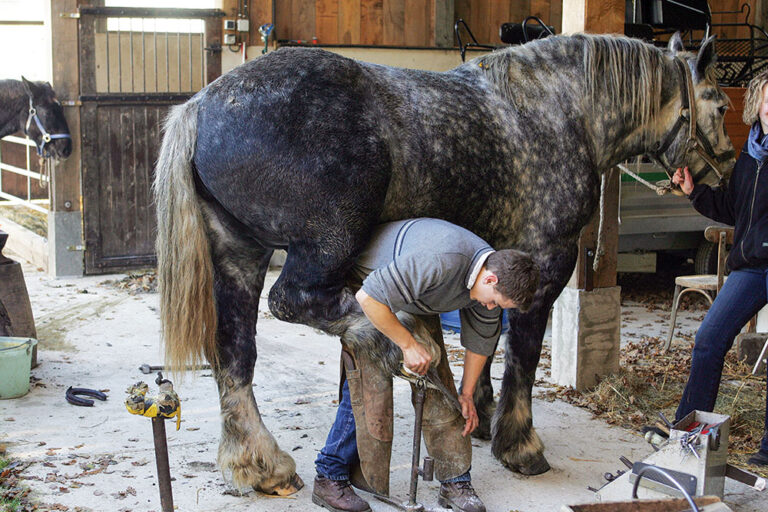
The University of Maine’s (UM) equine program received a donation from the Maine Farriers Association on Dec. 10.
Bone spavin in horses, or osteoarthritis of the distal tarsal (lower hock) joints, is a “common cause of equine lameness, resulting in lost training days and limiting affected horses’ careers,” says James Carmalt, MA, VetMB, MVetSc, FRCVS, Dipl. ABVP, ACVS, associate professor of Large Animal Surgery at the University of Saskatchewan, in Canada. He discussed the results of a recent small study on
Veterinarians and breeders can now detect pregnancy in mares using an ELISA (enzyme-linked immunosorbent assay) test that detects estrogen molecules in a mare’s blood sample and is cheaper and easier to perform than an ultrasound.
More than 1,000 readers of TheHorse.com responded to a poll asking, “Do you continue to ride your horse(s) during the winter?”
A California man is hoping a tip will lead to the recovery of his horse that was lost when flooding caused by last week’s heavy rains broke down the corral in which the animal was originally located.
The Pennsylvania State Police are seeking whoever is responsible for the shooting death of a pony earlier this month. Pennsylvania State Police Public Information Officer Steve Limani said the pony was discovered by its owners on Dec. 16. The animal had sustained a bullet wound to the head.
To combat joint disease or osteoarthritis in horses, many veterinarians have used autologous conditioned serum (ACS), also called by the product name IRAP (for the interleukin-1 receptor antagonist protein it contains), since the first scientific publication appeared on the subject in 2003. Since that time, a new kid on the block–a similar product sharing many characteristics with the original
Nine-time World’s Champion CH Gypsy Supreme, a 23-year-old American Saddlebred show horse who had lived in the Kentucky Horse Park’s Hall of Champions since 2001, was humanely euthanized on the morning of Dec. 22 after a long battle with laminitis as a result of equine Cushing’s disease. He had taken a sudden downturn the day before.
TheHorse.com’s Ask the Vet LIVE session on Feeding Foals and Young Horses, held on Dec. 15, is now available for listening on demand. Questions about developmental orthopedic disease in horses, grains, forages, supplements, breed differences, and more were answered by veterinarians Sarah L. Ralston, VMD, PhD, Dipl. ACVN, and Kenneth Kopp, DVM.
Stay on top of the most recent Horse Health news with
"*" indicates required fields