Placentitis Research Could Help Prevent Late-Term Abortions
Placentitis, which often is caused by an ascending infection that enters the mare’s uterus through the cervix, is the single most important cause of premature delivery of a foal.

Placentitis, which often is caused by an ascending infection that enters the mare’s uterus through the cervix, is the single most important cause of premature delivery of a foal.
It’s generally known that a mare gains weight during gestation, but University of Kentucky (UK) researchers are studying how much weight a normal mare should gain for the health of the fetus.

Before your stallion heads to the shed, make sure he’s in peak physical health and mentally prepared to handle the rigors of the breeding season.
Four researchers from the University of Kentucky (UK) Maxwell H. Gluck Equine Research Center and a faculty member in UK’s Department of Computer Science were among 58 co-authors of a research article published Nov. 6 in Science that reported the first complete sequencing and assembly of the horse genome.
Professors Jim Mickelson, PhD, and Stephanie Valberg, DVM, PhD, of the University of Minnesota College of Veterinary Medicine are among the authors of “Genome Sequence, Comparative Analysis, and Population Genetics of the Domestic Horse,” to be published in the Nov. 6 issue of the journal Science.
Many kinds of sexually transmitted diseases can affect horses; protect your stallions and mares from the most common offenders.
The University of Kentucky’s Gluck Equine Research Center will host its inaugural Stud Managers’ Short Course Jan. 20-21, 2010, from 8 a.m. to 5 p.m. each day, at Fasig-Tipton Sales Pavilion in Lexington.
Gluck Equine Research Center’s Dan Howe, PhD, has received a $500,000 grant from the USDA-CSREES Competitive Grants Program to conduct a Sarcocystis neurona genome project.
Established in 1986 as the Horse Bloodtyping Laboratory, the University of Kentucky Animal Genetic Testing and Research Lab (AGTRL) offers a number of testing services of value to practitioners, horse owners, and breed registries.
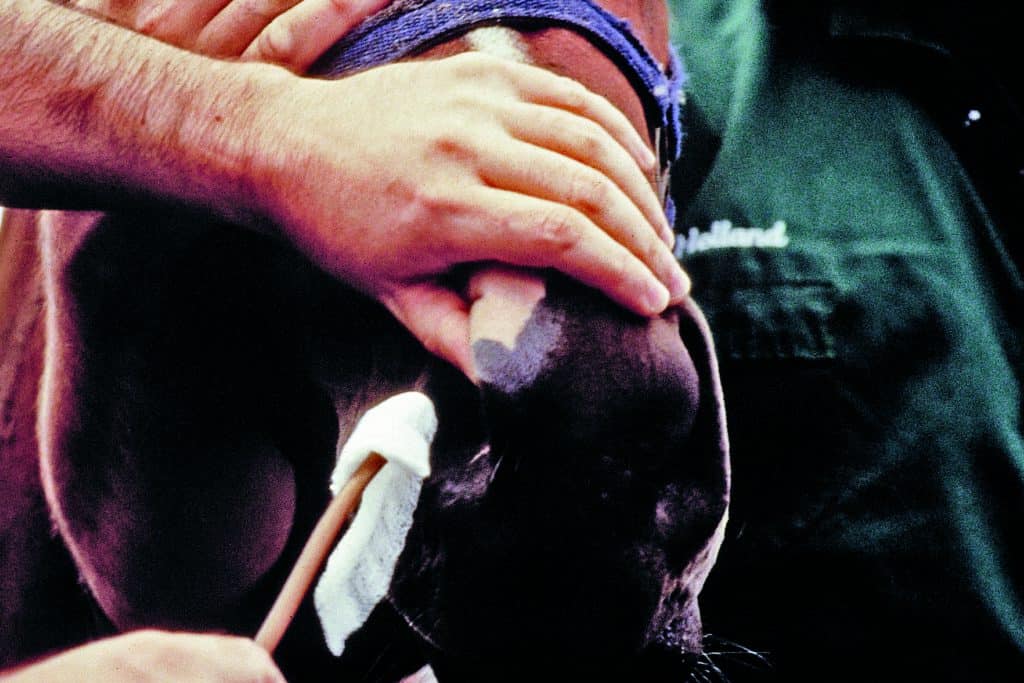
Recent EHV-1 outbreaks have been alarming in their high neurological attack rate in both vaccinated and unvaccinated horses. Therapeutic intervention with antiviral nucleoside analogs may limit the spread of the virus during an active EHV-1 outbreak while protecting infected horses from the crippling effects of severe neurological disease.
I have a 24-month-old Azteca colt that has dropped only one testicle so far.
These tests will simply be one more tool a breeder can use in addition to advice from bloodstock agents and veterinarians who, in turn, use radiographs, pedigree analyses, and other tools.
Mira, a foal born Aug. 4, runs happily in Binghamton, N.Y., even though her mother died almost a year ago from a ruptured intestine. Her birth was made possible through a team at Cornell that might be among the first to successfully extract and ship eggs from a dead mare for remote fertilization and implantation.
Between May 5 and June 15, the Livestock Disease Diagnostic Center (LDDC) diagnosed 13 foal loss cases caused by mare reproductive loss syndrome (MRLS) in Central Kentucky. This number was up slightly from 2003-2008 when only three to five cases were reported each breeding season.
James MacLeod, VMD, PhD, John S. and Elizabeth A. Knight chair and professor of veterinary science at the Maxwell H. Gluck Equine Research Center and director of UK’s Equine Initiative, was recently awarded two grants totaling more than $1.1 million over three years.
Researchers at the Gluck Equine Research Center will publish a study this fall on contagious equine metritis (CEM), a sexually transmitted disease in horses. Stallions are asymptomatic carriers of Taylorella equigenitalis, the causative agent of CEM, while mares may develop signs of an endometritis/cervicitis/vaginitis following exposure to an infection with this bacterium.