Rectal Examination of a Colicky Horse

 Horses with signs of colic can be grouped into one of three categories:

  1. horses which are resolved after medical management at the farm;
  2. horses which are resolved after more intensive medical management at a referral

Read More

Encephalomyelitis

The initials are innocuous enough–EEE, WEE, VEE–but the diseases they stand for can be deadly to both equines and humans. They are, in order, Eastern Equine Encephalomyelitis (EEE), Western Equine Encephalomyelitis (WEE), and Venezuelan Equine

Read More

EPM: Hope At Last

It seems to work! Because of research on new drug treatments for equine protozoal myeloencephalitis (EPM), horse owners might soon be able to kill the parasite that they now only can control effectively about 60% of the time. Preliminary researc

Read More

Venereal Disease in Horses

Venereal diseases are those that can be sexually transmitted. "Vener" is the Latin term for sexual intercourse and, hence, the origin of the term "venereal." The outcome of sexually transmitted diseases in horses can vary

Read More

Studies on Vitamin E

Researchers at Oregon State University and elsewhere are continuing to examine the role of vitamin E in horse health, including disease prevention and therapy. In particular, vitamin E deficiencies and/or supplementation could be important

Read More

Fescue Toxicosis

Mares grazing on tall fescue pastures infected with a toxin have increased gestation lengths, mare and foal deaths, agalactia (absent milk secretion after birth), retained placentas, premature separation of the placenta at birth, and increased placental weights and thickness.

Read More

Combined Immunodefiency in Arabians

A newborn Arabian foal is possibly one of the most beguiling creatures on Earth. Elegant of feature and blessed with beauty, he’s full of promise for the future–and often descended of royal blood and worth many thousands of dollars. Imagine how

Read More

Injured Riders Can’t Help Horses

Why doesn’t every rider wear an approved safety helmet, and wear it correctly, every ride? Statistics show that most people who are severely hurt in riding-related incidents suffer from head injuries. I guess it’s a lot like the debate concernin

Read More

Puncture Wounds in the Foot

Within this subject, it is also a good time to discuss simple foot abscesses, as they are a common–and often the best possible–outcome for a puncture wound to the foot. Generally before infection can take hold, the puncture must penetrate the dead

Read More

WEVA: On the Move

They met in Italy to exchange information about reproduction, sports medicine, infectious diseases, transportation, and surgery. The more than 300 delegates from 29 different countries, including Germany, Australia, New Zealand, Ireland, Denmark

Read More

Chronic Obstructive Pulmonary Disease

The official title for an all-too-common respiratory ailment in horses is chronic obstructive pulmonary disease (COPD). For the average horse owner, however, that rather cumbersome title has been reduced to a single word: heaves. Other people

Read More

Potomac Horse Fever Breakthrough

Potomac horse fever was an equine disease shrouded in mystery. Scientists knew what caused the illness–the bacterium Ehrlichia risticii–but its source in Nature could not be found. No one knew how horses became infected. Until now.

Read More

Give ’em Some Air!

Before I go into this column on my opinion about the legalization of clenbuterol (trade name Ventipulmin), I want everyone to know I am personally prejudiced in this area of discussion. Clenbuterol is a legal drug for horses with airway

Read More

Advances In Equine Nutrition: KER conference 1998

The nutrition conference for feed manufacturers presented by Kentucky Equine Research (KER) of Versailles, Ky., attracted more than 200 delegates involved in research and feed manufacturing from the United States, Europe,

Read More

Understanding Your Horse’s Teeth

Horses have a unique dental structure. Their teeth are divided into two major sections: the incisors, which are the teeth seen in the front of the horse’s mouth, and the cheek teeth, made up of the premolars and molars. The molars and

Read More

More From The Horse

White horse nose detail
Pferd im herbstlichen Wald
Fine art horse nose with black copy space
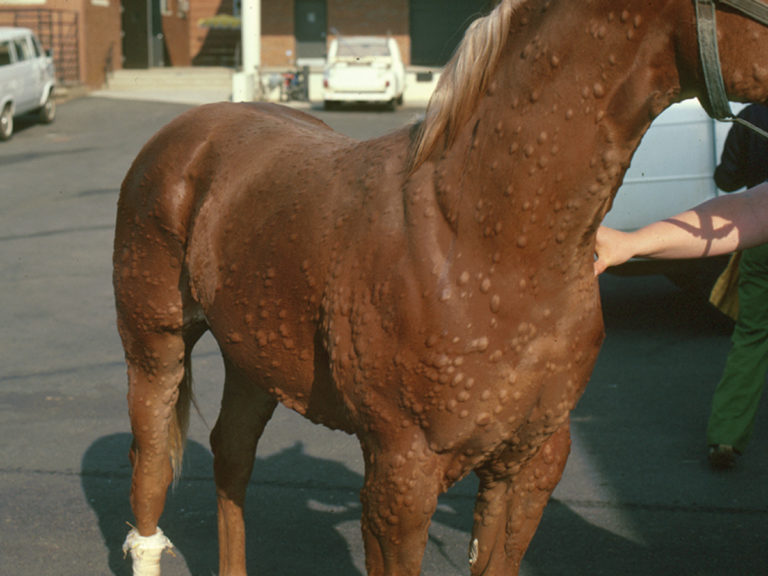
hives in horses

Stay on top of the most recent Horse Health news with

FREE weekly newsletters from TheHorse.com

Weekly Poll

sponsored by:

Create a free account with TheHorse.com!

The Horse
Privacy Overview

This website uses cookies so that we can provide you with the best user experience possible. Cookie information is stored in your browser and performs functions such as recognising you when you return to our website and helping our team to understand which sections of the website you find most interesting and useful.