Myristol’s Effects on Clinical Joint Disease

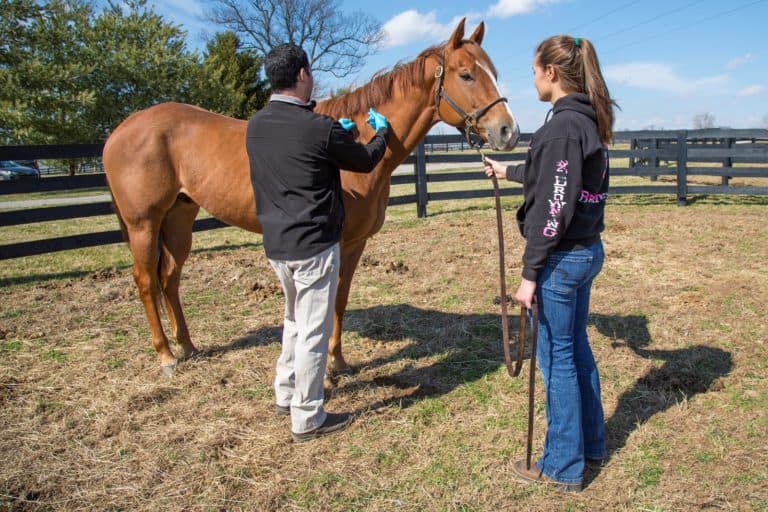
For the study, 39 horses in Missouri and Florida (on a broodmare farm, a Thoroughbred retirement center, and in two university equestrian programs) were selected for naturally occurring osteoarthritis that caused Grade 2-4 lameness on a scale of 0-4.
Read More

How to Airlift a Horse

“The process of airlifting a horse still carries inherent dangers for the horse and rescue personnel,” he concluded. “Risks may be lessened by a program that involves regular training, including a helicopter lift when possible, to increase the team’s

Read More

Examining the Equine Eye

The best equine test for vision is the “dazzle reflex,” a sensitive test for retinal function. An observer watches to see if the horse squints in response to shining a bright light into the injured eye.

Read More

The State of Stem Cell Therapy

Stem cell therapy has received a good deal of attention in both human and veterinary medicine in recent years. It holds theoretical promise for treating conditions ranging from traumatic tendon and cartilage injury to liver failure, Parkinson’s

Read More

Stapling the Gut

These days, in many species incisions are often closed with staples rather than stitches–and they’re not just for external use any more. At the 2007 American Association of Equine Practitioners Convention, held Dec. 1-5 in Orlando, Fla.,

Read More

First Aid for Limb Fractures in Horses

When a horse’s leg is fractured, the primary treatment goal is to stabilize the fracture site so the broken bone ends don’t further separate and do more damage. The outcomes of these cases often have a great deal to do with how well the broken

Read More

AAEP Vets ‘On Call’ to Assist at Racing Telecasts

Media-trained equine veterinarians representing the American Association of Equine Practitioners’ (AAEP) “On Call” program will support another season of live Thoroughbred racing on the major television networks. The “On Call” program is designe

Read More

Reducing Hindgut Acidosis

Acidosis (abnormally high acidity) in the hindgut (the large intestine and colon) can cause a number of problems in horses, including anorexia, colic, laminitis, and stereotypic (continuous, repetitive, and serving no purpose) behaviors such as

Read More

Traumatic Brain Injury in Horses

“Head trauma is common in horses, and a number of these cases will present with neurologic signs consistent with brain injury,” began Darien Feary, BVSc, MS, Dipl. ACVIM, ACVECC, a lecturer in equine medicine with the University of Sydney,

Read More

Pain Medications for Horses

Managing pain in horses is important for a lot of reasons: There are humane benefits in addition to medical ones, such as maintenance of weight, shorter hospital stays, and lower total patient bills. At the 2007 American Association of Equine

Read More

Correcting Large Colon Displacement

Left dorsal displacement of the large colon isn’t the most common cause of colic–only about 6-8% of colics are caused by this. However, up to 21% of affected horses tend to displace again, even after surgical correction. These horses often have

Read More

More From The Horse

Vet In Discussion With Horse Owner
Beautiful horses, animals, pasture, stables, horseback riding
Silhouette of a beautiful Arabian horse against sun shining through heavy fog, in sepia tone
electrolytes for horses; Why Do Electrolytes Encourage Horses to Drink?

Stay on top of the most recent Horse Health news with

FREE weekly newsletters from TheHorse.com

Weekly Poll

sponsored by:

What is your biggest challenge when caring for horses in hot weather?
124 votes · 124 answers

Create a free account with TheHorse.com!

The Horse
Privacy Overview

This website uses cookies so that we can provide you with the best user experience possible. Cookie information is stored in your browser and performs functions such as recognising you when you return to our website and helping our team to understand which sections of the website you find most interesting and useful.