Abscesses are a common lameness cause. What if your usual fix fails?

When your horse comes up three-legged lame, you’ll be forgiven for having a moment of panic. Chances are, it’s just an abscess. You’ll get it to rupture or drain, and your horse will be sound soon.
A hoof abscess typically consists of a pocket of infection located between the sole and underlying sensitive tissues in the hoof. Clinical signs include lameness (sometimes severe), heat in the affected hoof, and a strong or bounding digital pulse—as felt in the digital arteries at the back of the fetlock.
Why is it so painful? There are nerve endings in those sensitive tissues, of course. And everything is surrounded by a hard hoof wall. When the horse puts weight on the hoof, the infection has nowhere to go, and it hurts.
How Hoof Abscesses Form
The infection arrives by way of the hoof. Poor hoof quality is an abscess risk factor.
“If there’s a crack or crevices that bacteria can get up into, that’s a great way for abscesses to start,” says Craig Lesser, DVM, CF. Lesser, who trained as both a farrier and a veterinarian, completed a podiatry fellowship, and is a shareholder at Rood & Riddle Equine Hospital in Lexington, Kentucky.
Stone bruises, thin soles, or hot nails during shoeing are other known causes of abscesses. Hot or close nails are when a farrier drives a nail too close to sensitive tissues.
Often the infection occurs in the white line, where the hoof wall and sole meet, says Richard Mansmann, VMD, PhD, hon. Dipl. ACVIM-LA of Equine Podiatry & Rehab Consult Practice, in Chapel Hill, North Carolina.
Muddy, wet conditions can soften hooves and make them easier to penetrate. During abnormally wet summers, “we see a lot more abscesses,” notes Steve Kraus, BS, CJF, head of farrier services, senior lecturer, and section chief at Cornell University College of Veterinary Medicine, in Ithaca, New York.
“If we have a very dry summer, we see less of them because the feet are tougher,” Kraus says.
Conformation flaws such as toeing out can predispose a horse to abscesses because they place uneven forces on the hoof, he adds.
In this article we’ll focus on steps to take when faced with an abscess, especially one that lingers beyond typical treatment times.
Step 1: Treat the Initial Abscess
OPTION A: Manage It Yourself
When experienced horse owners know they’re dealing with an abscess, many choose to treat it themselves. They’ll soak the hoof in warm water containing Epsom salts and follow by wrapping the hoof.
Lesser suggests applying an Animalintex poultice pad to the sole, then a roll of Conform (absorbent stretch bandage), a cohesive bandage such as Vetrap, and duct tape.
After the abscess ruptures—and you’ll know when it does because it stinks, plus the lameness improves almost immediately—Lesser recommends a few days of non-steroidal anti-inflammatory (NSAID) drugs while continuing to soak and pack the foot. He says he continues to pack with an Animalintex pad until drainage stops, then switches to packing with povidone-iodine.
Lesser is adamant NSAIDs should come after the abscess ruptures, not before. “What these do is they shrink and consolidate the abscess and actually make it a lot harder to find,” he says. Though you might want to give your horse pain relief, he urges you to think of the big picture. “That anti-inflammatory actually will shrink the abscess and just make it slower to rupture.”
Your vet might advise you differently.
OPTION B: Get a Professional Out
Some horse owners prefer to have a vet or farrier look at the hoof before attempting to pack and soak it. Both will try to pin down the precise location of the abscess.
Kraus uses a thermal scanner to compare heat in the sound and unsound feet. During a visual inspection of the hoof, he’ll look for black spots or other obvious signs of where pathogens (disease-causing organisms) might have entered. Mansmann says he uses a wire brush or a hoof rasp to clean the hoof, making it easier to identify these spots.
Farriers and veterinarians often squeeze the hoof with hoof testers, which look like tongs, to see if the horse reacts. Kraus says he goes “around the clock” of the horse’s sole three times to see if the horse jerks his foot every time in the same place.
When they find a crack or entry point, professionals have various tools, including hoof knives, to open the abscess. Opening the abscess can get the drainage started. However, Mansmann and Lesser both discourage digging any further into the horse’s sole.
“I want to investigate that abscess up the wall because the wall is nonpainful,” Mansmann says.
After the vet or farrier gets the drainage started, it’s time to soak the foot and pack it for a few days to help it heal.
If your horse won’t leave his hoof in a bucket to soak, you might try Kraus’ trick: cutting off the top of a used IV bag, filling the bottom with an Epsom salts solution, putting the horse’s hoof into the solution, and then taping the bag around the leg to soak. The idea is to clean out the drainage site of pus and debris.
Step 2: Your Horse Is Still Lame. Now What? Call the Vet.
If you’re diligent about keeping the site clean and dry, abscesses typically heal quickly.
“You can see this thing heal up right before your eyes,” Kraus says. Relief can sometimes be immediate, though other horses might need a few days before they’re noticeably moving more soundly.
“(By) that three-day mark of not making consistent forward progress, I start worrying that maybe there’s something else going on,” Lesser explains. He defines progress as the horse being mostly sound at the walk within three days, with drainage being “minimal to none.”
The three-day deadline isn’t strict. “As long as every day we’re making progress in the right direction, I’m okay with giving us more time,” Lesser says.
If your horse isn’t improving and is still lame four or five days after the abscess first ruptures—or if the abscess never ruptures—our experts say you need to call your veterinarian and get some radiographs. Laminitis is the big fear. This happens when the lamellae (or laminae)—the Velcro-like tissues that hold the coffin bone in place within the hoof—become damaged and inflamed. In severe cases these tissues can separate, causing the coffin bone to rotate downward or sink.
Step 3: Hoof Radiographs
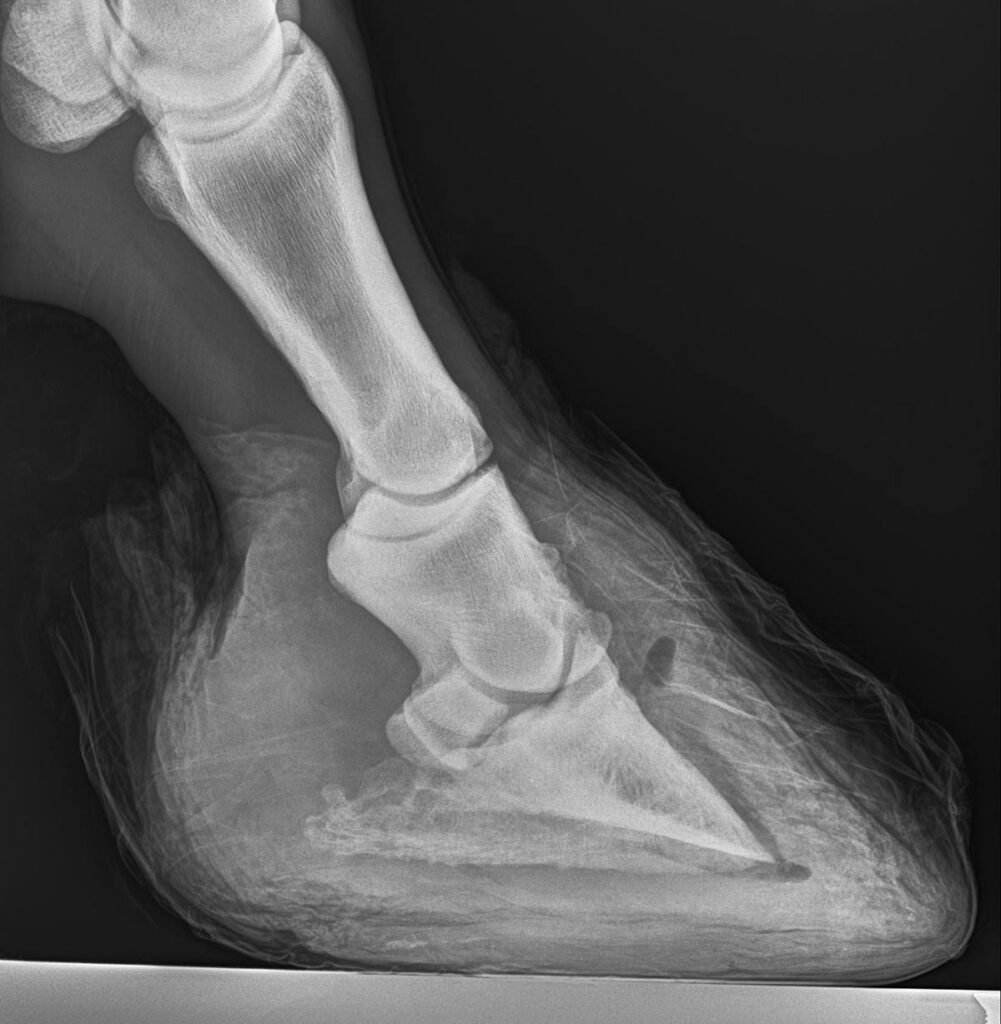
A horse that’s still lame even after a ruptured abscess needs radiographs. The images help the veterinarian ensure the problem isn’t something else, such as a coffin bone fracture, unilateral laminitis (in one foot of a pair), or another type of infection that can occur in the horse’s hoof, Lesser says (more on this in a moment).
If it’s not an abscess and you delay treatment, the problem can get very expensive, he adds, and some of the problems can be life-threatening.
For radiographs, he takes four views. This allows him to evaluate the entire coffin bone, checking for rotation and looking for subsolar abscess space beneath the coffin bone or going up the dorsal wall.
The X ray can show an abscess if bacteria within are producing gas. If it just contains pus, the abscess won’t show up because the fluid is the same density as the sole, Lesser says. If the X ray does show evidence of the abscess, that can guide treatment.
Step 4: Possible Post-Radiograph Diagnoses in the Horse’s Hoof
Radiographs allow the veterinarian to rule out other painful hoof conditions such as, again, laminitis; septic pedal osteitis, which is a coffin bone infection; keratomas, which are benign tumors; a sequestrum, where the body treats a dead, broken-off bone piece as a foreign object; or an actual foreign object in the horse’s hoof. Keep in mind that metal will show up on hoof radiographs but wood won’t.
Quittor, an infection in and around the collateral cartilage, found on either side of the coffin bone and believed to aid in hoof expansion and shock absorption, “often gets blamed on being a recurrent foot abscess as well.” It will show above the coronary band, Lesser says.
The most common nonabscess finding in situations like these is septic pedal osteitis. Radiographs will show a lucency—a dark spot—on the horse’s coffin bone.
The best news comes when the vet finds absolutely nothing.
“You know, 90% of the time the vet is going to take radiographs and say, ‘Hey, there are no changes on the bone, I think we’re okay,’ ” Lesser says.
Step 5: Treatments and Rehab for the Horse
Assuming your horse’s diagnosis didn’t change and the problem is still an abscess, you’re likely going to be soaking and packing again. At this point, Lesser switches the poultice he’s using.
“I reach for what we call an overnight poultice, which is a bran-mash-based poultice we can leave on the horse for 24 hours. That really helps us get drainage,” he says.
The overnight poultice helps get the horse’s foot extra wet so the abscess can rupture on its own—preferably not through the coronary band, Lesser says. But the important part is the abscess ruptures. If it happens in the coronary band, “you’re likely going to have a defect that’s going to have to grow out.”
It takes a year for the hoof to fully grow out, but the horse should be sound while that’s happening, Lesser says.
Your veterinarian or farrier might suggest shoes and/or pads while the horse recovers. “It’s just like a wound anywhere else, except it’s a place that’s very dirty,” Lesser says.
After the abscess stops draining, Lesser packs the site with povidone-iodine to dry out the tract and encourage the hoof to cornify (harden) quickly and prevent bacteria from entering. Some veterinarians prescribe antibiotics after the lingering abscess ruptures, though Lesser says he does that only with bone changes.
Step 6: Preventing Hoof Abscesses
Abscess prevention begins with good basic hoof care. “It starts with consistent trims,” says Lesser, who also suggests shortening the trim cycle could prevent hooves from cracking.
Mansmann agrees. “When in doubt, shorter is better on the cycle,” he says.
Shoes and pads might help protect the bottom of the foot.
Consider, too, how you might adjust the horse’s routine to help keep abscesses from developing in the first place. “In those wet, nasty environments, sometimes avoidance is the best thing,” Lesser says. That could mean “making sure horses’ hooves have a chance to dry out and also trying to avoid those deeper muddy areas.”
Take-Home Message
Any hoof abscess in horses can be frustrating to manage. One that won’t heal can be even more trying. Involve your vet and farrier to get an accurate diagnosis, and be prepared to treat the horse for as long as it takes. Time, patience, and dedication can all help resolve that aggravating abscess.