Review the latest research findings on horseshoes and hooves

Fewer than 200 evidence-based papers have been published on hoof care in the past 40 years, says Patrick Reilly, Grad. Dip., former chief of farrier services at the University of Pennsylvania School of Veterinary Medicine, in Kennett Square. Of those, only a fraction focus on how horseshoes affect a horse’s hoof.
Reilly explains that most of what scientists know about the interaction between shoes and bones in the feet comes from research completed in human athletes. As a subject in a University of Delaware biomechanics study, he learned that wearing shoes changes the function, bone density, and structure of the foot.
“That is really similar to what I think is going on with horses,” he says. “Do horseshoes change the structure of the foot? Probably. I don’t think anybody has a problem saying that, but that doesn’t make horseshoes inherently bad.”
Vanessa Dahl, MS, a PhD student in animal science at the University of California, Davis, School of Veterinary Medicine, agrees.
“Shoes have a purpose in protecting a horse’s foot,” she says. “We ask horses to do jobs or athletic events that go beyond the wearing down of hoof under natural circumstances, so shoes help to protect them from that excessive wear.”
She adds that modern breeding trends focus on athletic capability rather than hoof quality. As a result, the genetic selection for good hoof quality tends to be poor. So, in the case of protection, shoes can significantly impact keeping horses sound, especially those with poor hoof quality.
Reilly and Dahl say much more research is needed to better understand how horseshoes influence the hoof and a horse’s gait, but here’s a look at what studies reveal.
Studies Exploring the Impact of Horseshoes on Hooves
One of the primary concerns critics have regarding horseshoes is their potential to restrict the natural expansion and contraction of the hoof during locomotion. Researchers on these four studies sought to understand this connection.
1. “Heel movement in horses: comparison between glued and nailed horseshoes at different speeds” (tinyurl.com/5n6h5pth)
In 2010 a research team in Japan examined whether shoes affected heel movement. They evaluated different shoe types but focused on direct-glue aluminum shoes, finding that glue-on shoes “restricted heel movement, suggesting possible interference with shock absorption and blood pumping in the hoof.”
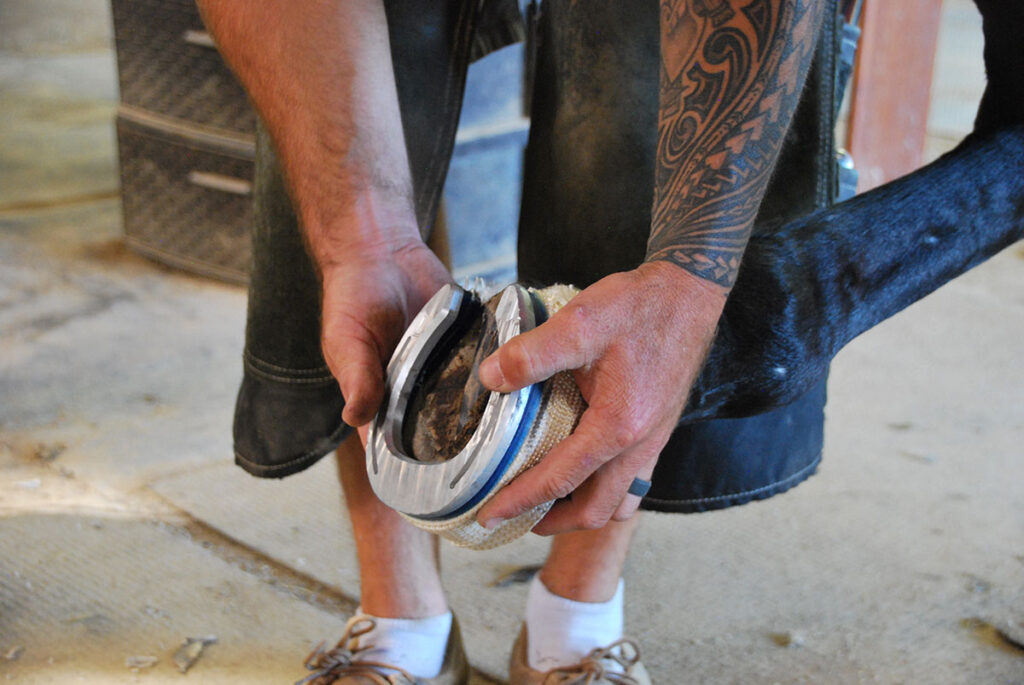
“Did the glue-on shoe affect heel movement in horses?” Reilly asks. “The answer was absolutely. But I would also say there are a lot of horses that compete in direct glue-on shoes.”
When Reilly direct-glues a shoe, he tends to do so for short periods. He limits their use to two to three shoeing cycles and then gives the horse a break or uses other footwear, such as flexible polymer shoes, to circumvent the issue.
“We can create problems by immobilizing the foot and not letting it deform enough,” he says. “The trouble is when all that strain builds up in the hoof, it has nowhere to go and eventually starts damaging some of the tissue in the hoof. That’s an extreme case, and common sense says that (with) different horses, different feet, and different amounts of heel movements—there is a happy medium.”
2. “The effect of horseshoes and surfaces on horse and jockey center of mass displacements at gallop” (tinyurl.com/4f5c24tz)
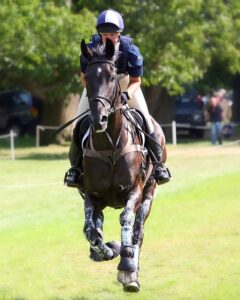
In 2021, researchers at the Royal Veterinary College (RVC), in the U.K., released findings after investigating the impacts of horseshoes on horses and jockeys when the horses were galloped on different surfaces. The RVC summarized key findings on its website, and they include:
Vertical (dorsoventral, extending from the back to the underside) displacements differed most significantly among the tested conditions.
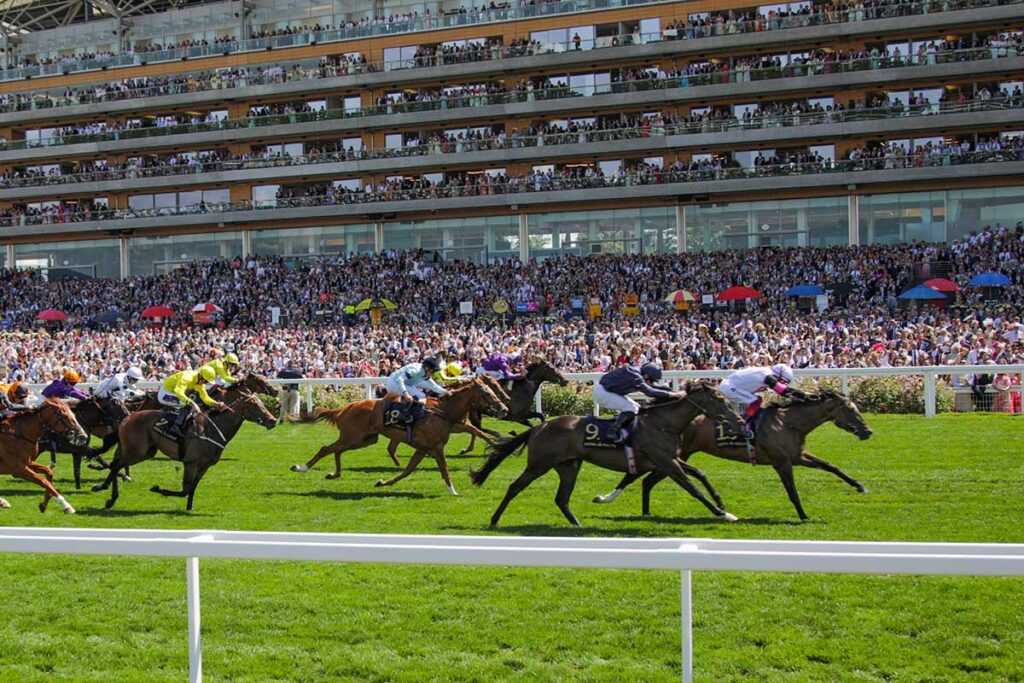
The artificial track surface resulted in increased vertical displacements compared to turf, possibly due to greater hoof sinking on impact and increased push-off.
Aluminum shoes and barefoot conditions produced similar vertical movement changes, while Glushu (a type of glue-on shoe) and steel shoes yielded different patterns, likely due to differences in shoe mass.
The artificial surface and steel shoes resulted in the least forward-backward (craniocaudal) jockey movement, suggesting they might provide greater stability.
The researchers also found relationships between horse and jockey displacements across different shoe-surface combinations:
The largest difference in vertical displacement between horse and rider corresponded to the smallest difference in craniocaudal displacement (GluShu on artificial surface).
The opposite was true for aluminum shoes on turf.
Generally, displacement patterns differed between artificial and turf surfaces, suggesting that different shoe-surface combinations might require the horse and rider to adjust or compensate to maintain stability during a stride cycle.
“Differing surfaces can really change the mechanical effects of the shoeing,” Reilly says. “The horse’s hoof interacts differently with the ground, changing the traction and distribution of load across the sole and frog.”
He emphasizes that we are a long way from understanding what is ideal or correct in farriery but should remember that hoof balance changes in different ground surfaces. Last year he published the paper, “The influence of different horseshoes and ground substrates on mid-stance hoof orientation at the walk” (tinyurl.com/4nkj779n). He and his co-authors found the hoof angle at mid-stance of a walking front limb increased by almost 5 degrees in soft footing.
Rider feedback is important because there aren’t enough answers yet, he says.
3. “Short communication: changes in gait after 12 weeks of shoeing in previously barefoot horses” (TheHorse.com/1121612)
In 2023, a team at the University of Connecticut published a paper in which they explored how fullered shoes (the groove around the nail holes) and plain stamp shoes impacted movement. At the study’s start researchers took baseline measurements of 14 horses. The measurements included a lameness score and inertial motion sensor measurements on the symmetry of each horse’s gait before the study began and then after trimming and shoeing.
“Shoeing previously barefoot horses using industry-accepted farriery protocols increased maximum hock angles at the trot and reduced lameness scores,” noted a written summary from the university.
“Overall, the findings suggest that hind-limb shoes may be helpful to athletic horses,” farrier Katelyn Panos, a co-author on the study, told The Horse. “Open communication between the farrier, veterinarian, trainer, and owner is critical.”
4. A Study of Movements and Forces With and Without Shoes

During the Tokyo Olympics two show jumping horses competed barefoot. Both were part of the gold medal team from Sweden, and one claimed the silver medal in the individual competition. That has sparked a deeper discussion on the ability for horses to perform barefoot.
Preliminary data from a study led by Lars Roepstorff, DVM, PhD, a professor at the Swedish University of Agricultural Sciences, in Uppsala, are highlighted on the university’s website: “Traditional iron shoes change the hoof’s ability to expand. The shod hoof cannot expand or contract as much as the barefoot hoof, because the shoe inhibits lateral movement. It could mean that the blood flow in the hooves is inhibited, the blood flow is important for the hooves to be healthy and damage-free. However, to be able to draw such conclusions, further studies are required.”
Roepstorff led a team of researchers using high-speed cameras to study a group of horses ridden over fences with and without shoes on the same indoor surface. However, in interviews Roepstorff cautions that whether a horse should go barefoot or be shod is a complex question. The answer, he says, depends on the individual horse, on the riding surfaces, and other factors.
“With the advent of so many new shoe types and materials that have come on to the market, as well as different ways to attach them to a hoof that allows the hoof to move more like a barefoot hoof does, I think we’re starting to see some real progress in shoes that protect the foot while allowing the hoof to mechanically behave like an unshod hoof,” Dahl says.
How Do Horseshoe Nails Affect the Hoof?
Horseshoes are one part of the equation. Nails are another. While a master’s student, Dahl investigated shoe-wear patterns of racehorses training and racing at four California racetracks. She aimed to find out if natural wear patterns, caused by the hoof expanding and rubbing against the shoe under load, differed between dirt and synthetic racing surfaces.
“The biggest standout from that study was that the closer the nails were to the heels of the shoe, the smaller the wear patterns became,” she says. “This indicated that the hoof wasn’t moving as much when nails were closer to the heels. While it’s common knowledge among farriers to not nail past the wide part of the hoof (medial/lateral aspect), it was a little surprising to see this practice happening at the racetracks.”
From her initial observations, Dahl launched the study “Hoof Expansion, Deformation, and Surface Strains Vary with Horseshoe Nail Positions” (tinyurl.com/mj769zu2) to test how much the nails impact hoof expansion and distortion compared to an unshod hoof.
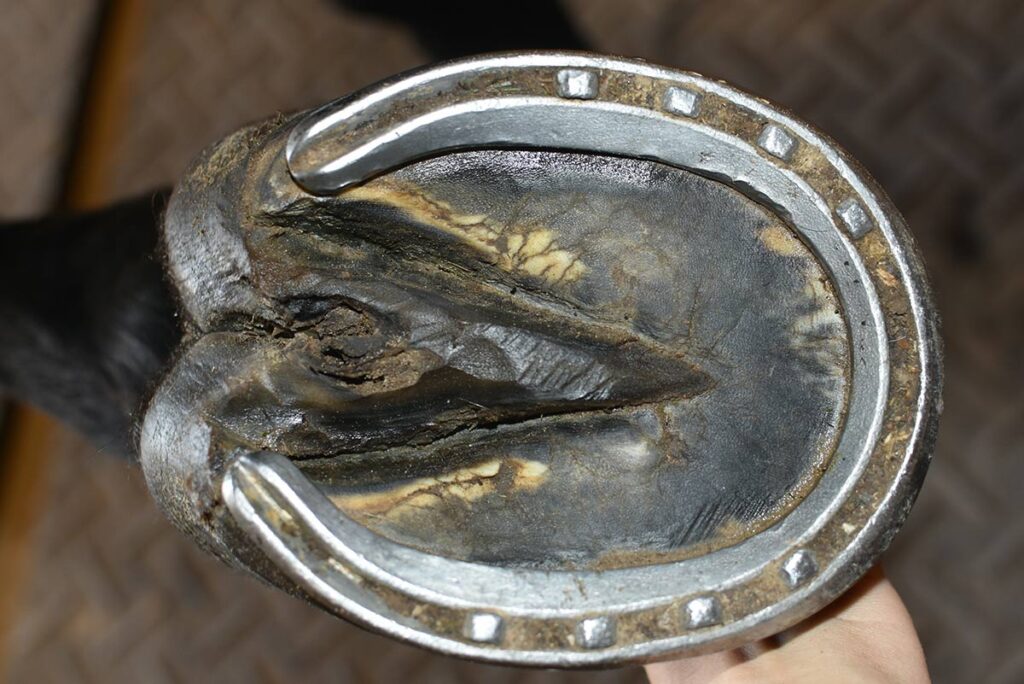
One unexpected finding, she says, related how the proximal quarter (along that wide part of the hoof mentioned earlier and higher up the hoof, toward the coronet band) responded with the addition of just nails at the toe compared to nails at the toe and the quarter.
“The nails at the toe I expected to have the least effect on hoof wall distortion, as this was the least restrictive of the nail placement options,” Dahl says. “Additionally, the nails at the toe and quarter locations were essentially the same as where nails are placed for normal shoeing (from the wide part of the hoof toward the toe). I also expected the hoof to move somewhat similarly to an unshod hoof as the heels were still free to expand.”
However, under both conditions, the proximal quarter expanded more than either an unshod hoof or a hoof under the most restricted condition with nails at the toe, quarters, and heels. In fact, the proximal quarter of the unshod and more restricted feet responded similarly, which Dahl and co-authors attributed to not restricting the distal part of the hoof (closer to the ground) or restricting it in a more uniform manner.
“This tells us that even under normal shoeing conditions with the nails placed at the quarter toward the toe, having a shoe attached with nails alters the hoof’s mechanical behavior, at least at the proximal end of the quarter,” she says.
To a degree, nails fix a hoof into place with the shoe, which is necessary to keep it in place, so the horse doesn’t just twist or slip out of it. However, shoes tend to loosen by the end of the shoeing cycle because the hoof wall wears at the nail holes with each load, causing them to widen, says Dahl.
“Nail placement is an important factor as nails placed closer to the heels can restrict the heels in a manner that changes the strains the hoof wall experiences by reorienting them, indicating that over time, the nails could pull heels forward and be a potential cause for developing an underrun heel,” she says. “It’s also possible that normal shoeing could affect forces at the coronet band (located) at the quarters, potentially leading to additional hoof problems, though those types of changes should be further investigated to better understand whether that additional expansion is detrimental or not.”
What Horseshoe Research Do We Need Next?
How horseshoes impact hooves is complex. Ultimately, the goal is to find a balance between protecting the hoof and preserving its natural biomechanics.
“I would love to see longer-term studies testing different shoe types, trimming methods, and shoe attachments to measure just how all of these components affect the hoof conformation over time,” Dahl says.
Those are just a few of the questions Reilly and a team of researchers will explore further, thanks to a generous grant from the Morris Animal Foundation. The project will include observations from a dozen farriers across North America who will collectively follow 20 horses. The farriers will take photographs and perform gait analysis at the start of the study and then again after each trimming and/or shoeing cycle over one year. “Hopefully, we can see what the link is between hoof morphology (the shape and structure) and hoof care and gait symmetry,” he says. “Ideally, we’ll be able to answer questions like, ‘Are horses more symmetric early in the shoeing cycle or later in the shoeing cycle? Do feet grow at different rates at different times of the year?’ In my mind, this is the type of information we need more of.”