Healthy, well-maintained hooves can remain strong and functional for decades—supporting horses from their first wobbly steps to their final years.
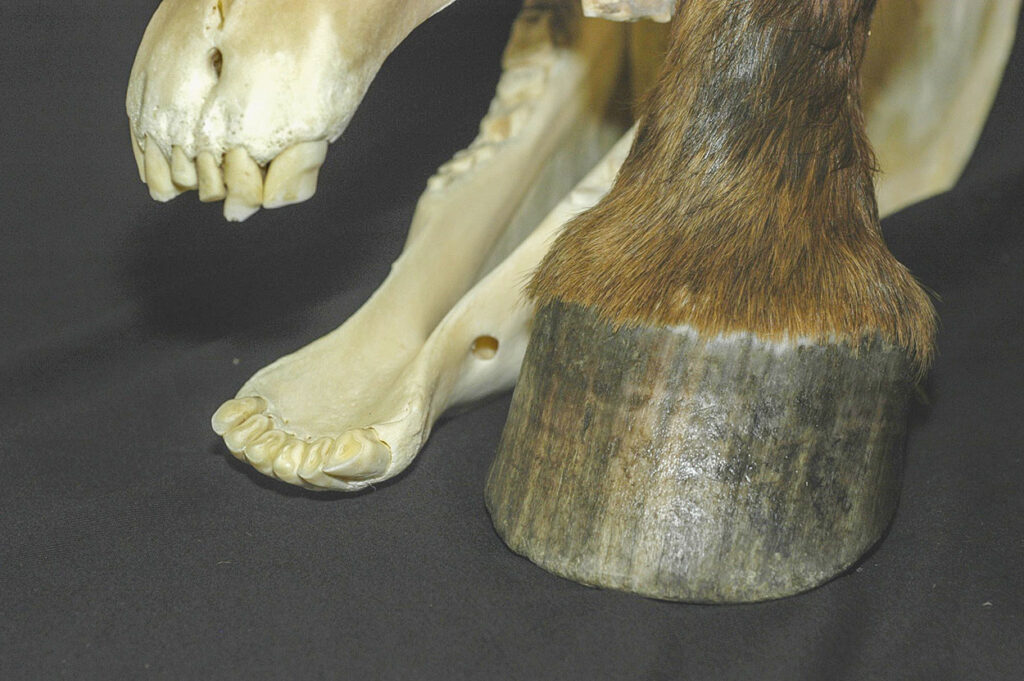
Hellhole Mare was, actually, an angel of a horse. A cherished favorite among equine hoof scientists who study Brumbies—Australia’s free-roaming feral horses—the tough but gentle bay had given birth to at least 15 foals before becoming so thin and weak that researchers opted to humanely euthanize her.
When the scientists, with heavy hearts, examined this beloved matriarch, they discovered “skin and bones” and toothless jaws, says Chris Pollitt, BVSc, PhD, head of the Australian Equine Laminitis Research Unit at the University of Queensland.
One part of her body, however, showed no signs of age whatsoever—the very foundation she’d been standing on for nearly three decades. Her feet. “Nicely beveled along the edges, strong heels, no laminitis, perfect,” says Pollitt. “You’d think they’d been trimmed by a professional.”
For Pollitt and his colleagues Hellhole Mare epitomizes the equine hoof. “She was nearly 30 years old, but she had the feet of a 5-year-old,” he says, having lived in what Pollitt considers an ideal environment for natural hoof care in an unridden and freeroaming horse. “This tells us that if a horse’s foot is properly cared for, it will be perfect when the horse reaches the end of its life.”
Horse Hooves In Utero
Hooves form remarkably fast, becoming easily recognizable within 65 days of gestation, says Simon Curtis, PhD, FWCF, Hon-AssocRCVS, a farrier in Newmarket, U.K. That’s before limbs have bones, he says.
To prevent uterine damage from fetal kicks, an unborn foal develops a gelatinous horn covering. This protective layer, called the eponychium or deciduous hoof, is derived in part from the sole and white line.
The basic hoof structure fully forms before birth, Pollitt says. But because unborn foals’ hooves never bear weight, their suspensory apparatus—where the coffin bone hangs from the front hoof wall via lamellar structures—remains underdeveloped. The lamellae, which help distribute weight and support hoof function, also do not fully develop before birth. In fact, he explains that because of that lack of weight-bearing, the embryonic hoof’s first and second lamellae form a distinct crisscross pattern, positioned almost perpendicular to each other.
The First Five Months
Healthy foals usually make a wobbly stand on their hooves within the first hour of birth, and they shed their eponychium within a few hours. Pollitt says such weightbearing triggers immediate loading of the suspensory apparatus. Within a couple of days, lamellar structure angles already reflect their new loading—taking on the oblique form they maintain for the rest of the foal’s life.
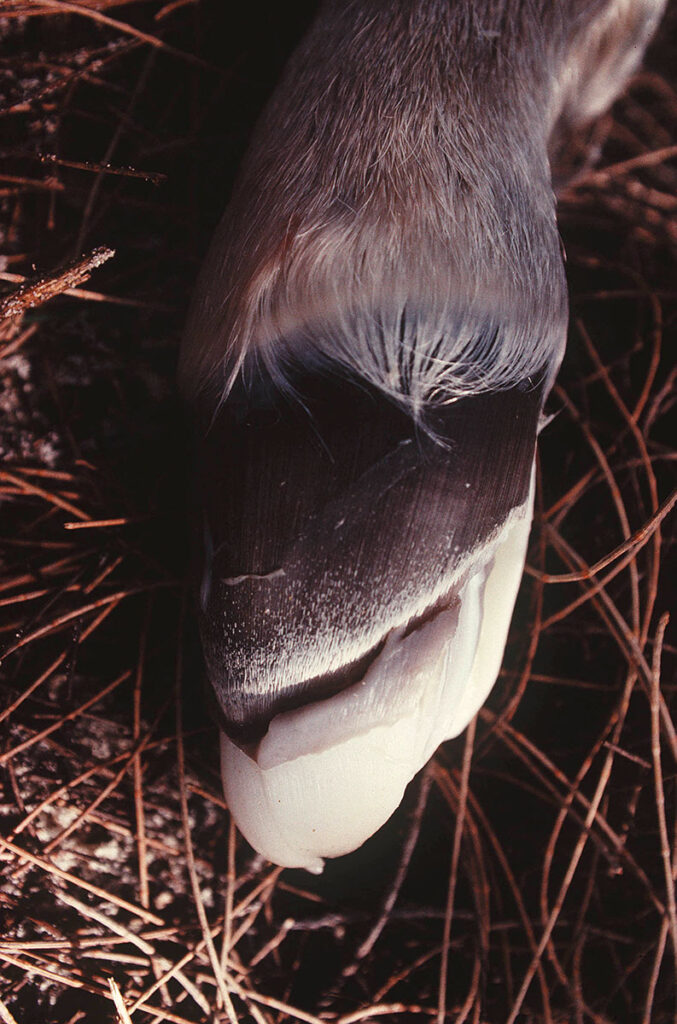
Meanwhile, their tiny hooves start growing their first palmar processes—a sort of “hook at the back of the bone to which the cartilage is attached”—which are completely absent at birth, Pollitt says.
Despite these changes, though, foal hooves evolve in neither shape nor structure after birth. “The original foal hoof is a certain size—say, the size of a cup—and it can’t grow any bigger,” he explains.
Instead, new horn grows rapidly from the coronary band, at a rate of about 15 millimeters per month, to create a new, mature hoof that widens and flattens over approximately five months, says Curtis. In general, that leaves a clearly visible horizontal “birthmark” line on the descending horn.
This creates a sort of “inverse cone” by three or four months of age, with greater width at the coronary band than the bottom, he explains. That’s, in part, because the foal’s hoof wall thickens more than threefold as it grows from the top down.
Meanwhile, other structures inside the foot—bones and lamellar attachments, for example—must grow along with the horse, Pollitt adds. “Lots of things are happening inside the hoof capsule after birth,” he says. “And all of these changes have to occur in synchrony, in a coordinated fashion.”
In general, this runs remarkably smoothly, he says. “It’s marvelous to consider what—and how many—things could go wrong,” he explains. “It’s like a miracle.”
Still, things can go wrong, especially when conditions aren’t favorable to good hoof growth. Selective breeding for big bodies and small hooves, for example, can negatively impact hoof development. Rigid or oversoft terrains can as well, as the researchers have seen in feral horses.
The first few months also represent the sweet spot for club foot development. Typically, hoof horn at the heel grows faster than at the toe, which occurs especially when foals favor walking on their toes, Curtis adds. Club feet, characterized by an upright shape, long, contracted heels, and a pronounced or bulging coronary band, can sometimes go unnoticed for months or years. In his research, however, he has found they usually appear between 20 and 110 days.
In domestic settings these early months represent a critical time for skilled, frequent trimming to prevent club feet, angular deformities, and other distortions, Pollitt says.
The Rest of the First Year
As foals continue to grow, their hooves undergo significant changes as they gradually develop into the familiar adult form.
“Suddenly we see this hoof taking on the shape that we associate with hooves—which is now a truncated, oblique cone, that leans slightly backward,” Curtis explains.
The new, mature hoof structure usually lasts the rest of horses’ lives, Pollitt says.
Minor tweaks do continue. Horn growth, for example, gradually slows to around 9 millimeters per month by the horse’s first birthday, Curtis says.
Loading patterns—which start as weanlings but become more prominent as the horse’s weight increases—also come into further play, he says. Through pressure readings he found horses “don’t stand like table legs” but, rather, favor inner (toward their midline) versus outer hoof-wall loading.
Suspecting that loading was impacting natural hoof growth patterns, Curtis sought to “separate the changes horses are preprogrammed to experience versus those in response to uneven loading.” He realized the horn compresses under the horse’s weight. That means even if the hoof grows at the same rate across the coronary band, it ends up seeming shorter or longer in different parts of the hoof due to getting smashed.
As a result, the outer angles from the sole to the coronary band appear more oblique, or slanted, and give the impression that outer walls grow faster.
“Farriers recognize this, and they say it grows more hoof on the outside,” he says. “But it’s not because of the production of horn cells; it’s because of the compression.”
Dorsal (front wall) angles also change in the first year at a rate of about one degree per month until about 10 months of age, Curtis says. “So, there’s an extraordinary change in angle.”
Hooves During the Rest of Life
Once a hoof has become mature—at around 10 months of age—it changes very little in healthy horses, says Pollitt.
“My feeling is that horse’s hooves, once grown and once properly cared for and in the right environment, will virtually outlive the horse,” he says.
“A lot of people think that they age—and they’ll tell you that they do, and they’ll supply anecdotal evidence to support that,” he adds. “But my experience is that they’re a wonderful piece of evolution that serves the horse well throughout its life.”
Even so, minor natural changes occur, Curtis says. For example, hoof wall thickness increases to about 9.5 millimeters in an adult Thoroughbred, or around 11 millimeters in other breeds. And horn growth slows to about 6 millimeters per month for adults and even to 3 millimeters per month for seniors.
Researchers on an ongoing pilot study, meanwhile, seem to have confirmed what many farriers have long suspected—that with age, hoof angles continue to mildly flatten compared to the ground, Curtis says.
Still, it’s also possible older horses simply have changing hoof angles due to evolving trimming techniques, especially as owners change farriers, Pollitt says.
Despite these minor changes, though, our sources say owners often perceive age-related changes in their horses’ hooves. “It’s such a rarity that farriers find horses with symmetrical hooves,” Curtis says, and that might be in large part due to unnatural loading rather than age itself.
Age-Related Conditions
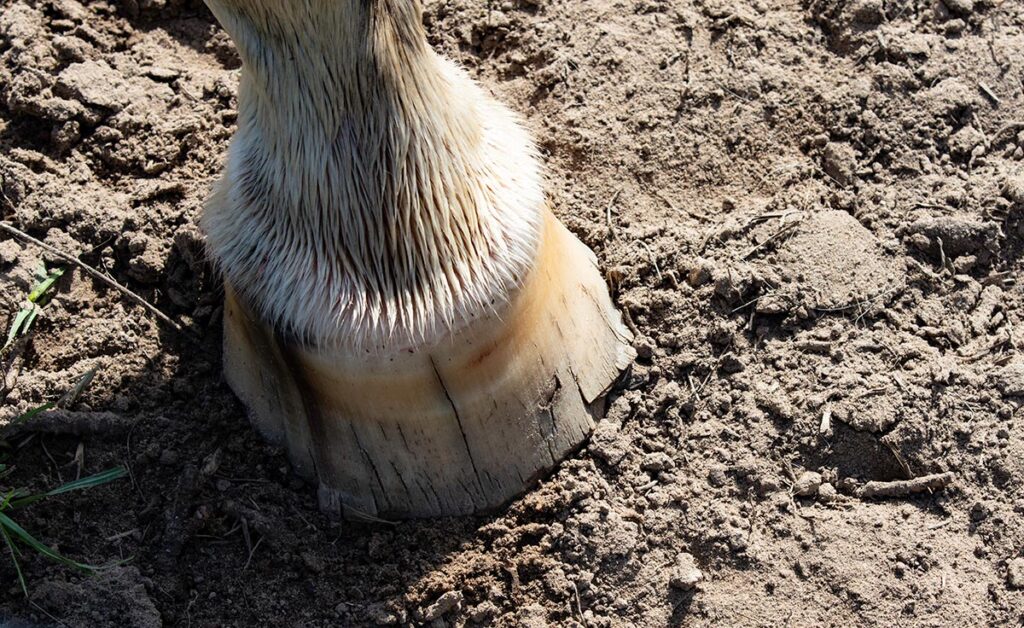
While hooves can remain strong over time, they are still vulnerable to age-related diseases and other conditions.
Many older horses suffer from low-grade laminitis, Curtis says. It is often due to excess nutrients, which weaken the laminae by altering the endocrine system, usually in combination with obesity. Besides contributing to rotation or sinking of the coffin bone within the hoof, that excess weight causes compression, especially along the sole.
Horses with age-related insulin resistance—especially related to pituitary pars intermedia dysfunction (PPID, equine Cushing’s disease) and/or obesity—can have chronic laminitic changes, Pollitt says.
That could mean they have a healthy back half of the foot but compression and changes in blood supply to the front half, Curtis says. These issues combined with a slight change in hoof angle could make the problem even more pronounced.
“As a horse ages, you might notice some changes in its hoof that are more related to age-related health conditions, such as Cushing’s (PPID), rather than changes in the hoof due to older age,” says Shannon Pratt-Phillips, PhD, a professor of equine nutrition in North Carolina State University’s Department of Animal Science, in Raleigh. “Good nutrition will still be important to support hoof health even with confounding factors such as Cushing’s or insulin dysregulation.”
Beyond endocrine disorders, geriatric horses simply have more years of impact on their feet—meaning greater chances of injury, such as to the coronary band, Curtis says. “Older horses definitely tend to have more problems, but I think it’s more a cumulative effect,” he explains. “There’s not a single problem that’s more a 20-year-old hoof compared to a 5-year-old hoof.”
Other issues might stem from a lifetime of environmental challenges—such as feral New Zealand horses navigating through rough terrain—rather than the aging itself, Pollitt says.
Likewise, aging, retired domestic horses could suffer from poor hoof health simply because they might receive less hoof care, he explains.
“A lot of people neglect their old horses,” he says. “Of course, if the environment is soft underfoot, they’ll develop long cracks, and they might be euthanized because of the condition of their feet. And (owners) say they’re an old horse with an old foot. But I don’t believe that, intrinsically, there’s aging about the hoof.”
Older horses might also experience nutritional and environmental deficits due to their decreasing social rank, says Pratt-Phillips.
“They end up standing in the mud all the time, or not getting their full ration, because the higher-ranking horses take their place,” she explains.
“Of course, the horse is old, and there will be the assumption that it’s getting old and, so, the hoof is falling away,” Pollitt says. “But in my experience many horses reach old age with hooves that are the same as when they were 3 years old.”
Take-Home Message
Hooves are phenomenal structures built to last a horse’s lifetime. Even so, they experience major changes in shape and structure through the first year out of the womb, while they adjust to bearing the weight of the foal. Once mature, healthy and properly maintained horse hooves can remain strong and functional throughout an animal’s life—provided equine veterinarians and horse owners manage all age-related diseases.