Carriage Horse Controversy Causes Veterinarian’s Suspension
An ASPCA veterinarian was suspended without pay after providing conflicting information to media outlets.

An ASPCA veterinarian was suspended without pay after providing conflicting information to media outlets.
Balancing the digestive system is key to maintaining equine health by improving nutrient absorption.
Rood & Riddle Equine Hospital, located in Lexington, Ky., will host a free gastroscopy event on Oct. 18.

Recent studies show that gastric ulcers occur in a surprisingly high percentage of performance horses.
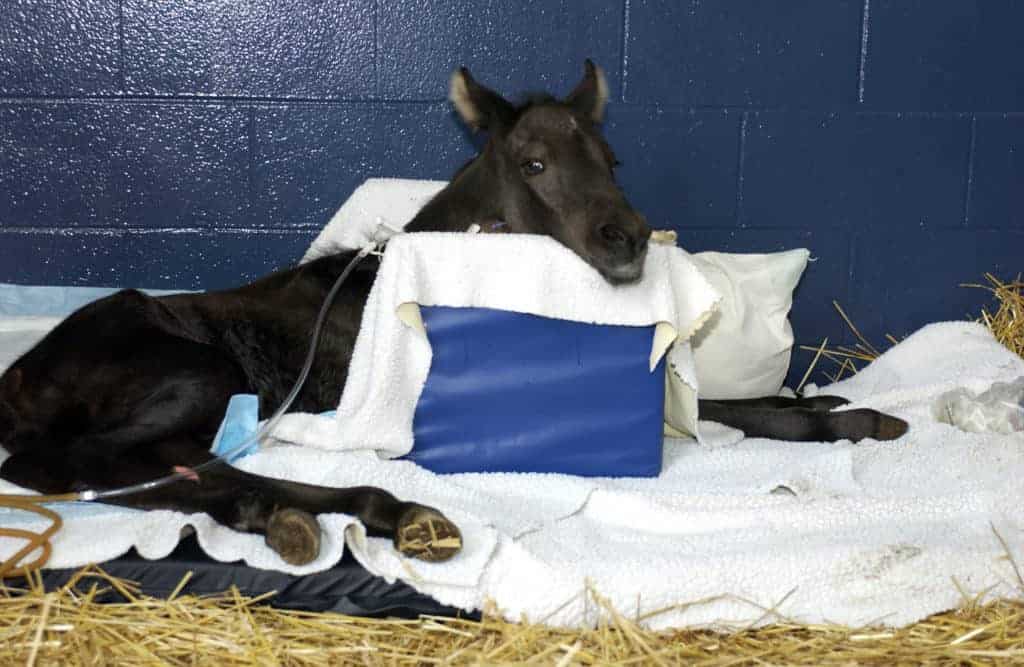
Meconium impaction, ulcers, diarrhea, and other GI problems can arise in foals.

Adjusting what a horse consumes can help prevent or squelch some equine ailments.
Gastric ulcer syndrome can be time-consuming and expensive to treat. Learn how to use nutrition to manage

Gastric ulcers can affect horses of all breeds, ages, shapes, and sizes, including weanlings.
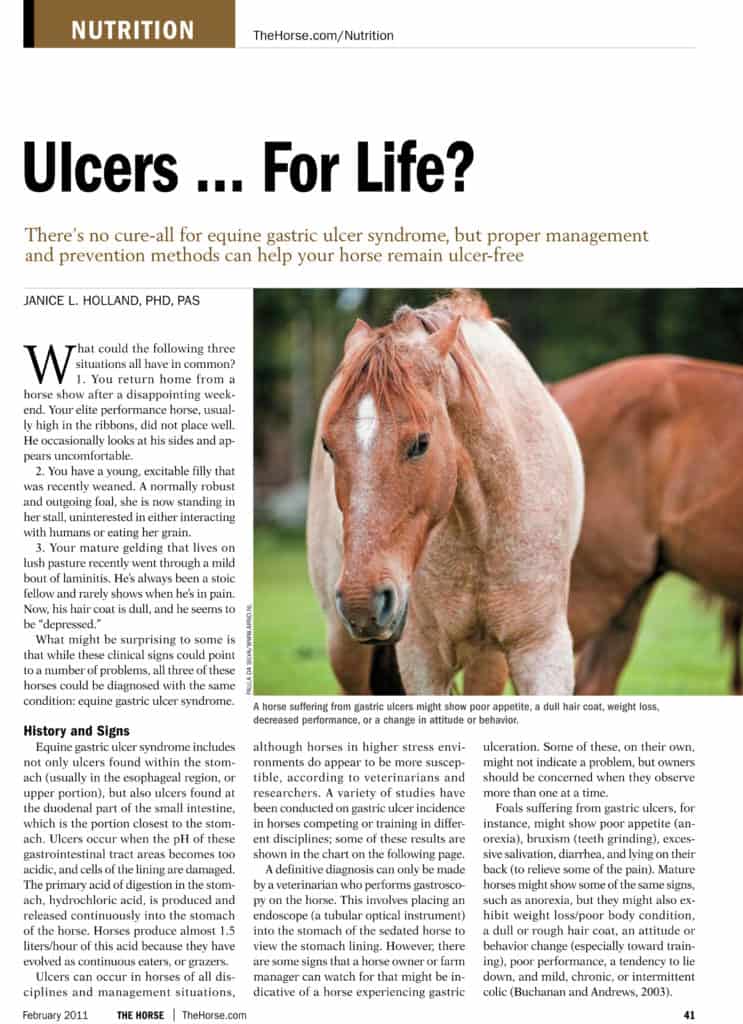
Ulcers can occur in horses of all disciplines and management situations, although horses in higher stress environments do appear to be more susceptible. There’s no cure-all for equine gastric ulcer syndrome, but proper management and prevention methods can help your horse remain ulcer-free.
The bacterium Helicobacter pylori, a known disease-causing organism in human medicine, does not appear to be important in horses.
In humans, intensive research efforts have revealed that H. pylori can induce chronic gas
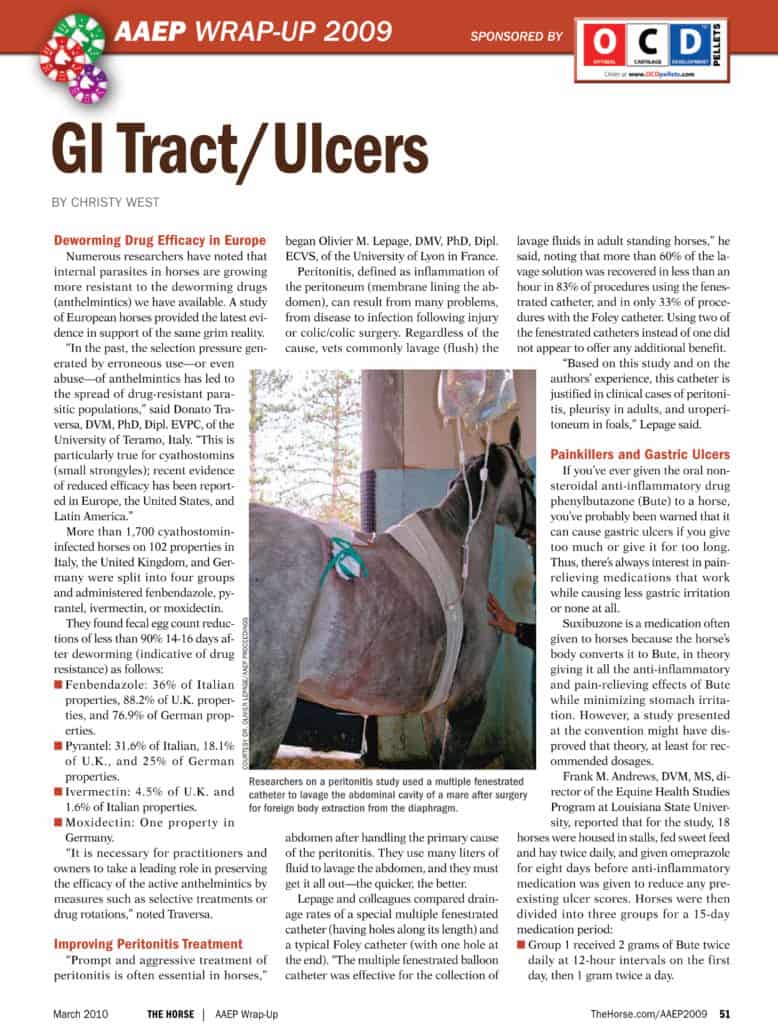
Deworming medication resistance, persimmon risks, peritonitis treatment advances, Salmonella biosecurity guidelines, and more equine gastrointestinal topics were discussed at the 2009 convention of the American Association of Equine Practitioners.
“This is giving me an ulcer!” These probably are words our horses would utter if they could speak because many performance horses and racehorses develop

Ulcers can affect horses in as few as five days–from the competitive athlete to the pleasure horse.
Breeding season can be a stressful time for owners and horses alike. While horse owners are hustling to prepare facilities, the broodmares might be just as tense. Especially for young and maiden mares, the stress from being trailered to new
Sign up now for the free Webinar on Equine Ulcers: Your Horse At Risk.
Every competitive horse owner knows that showtime is stressful. However, stress from training to trailering can affect horses, too.
Horses can continue feeling the stress even after stepping off the trailer. Situations such as increased