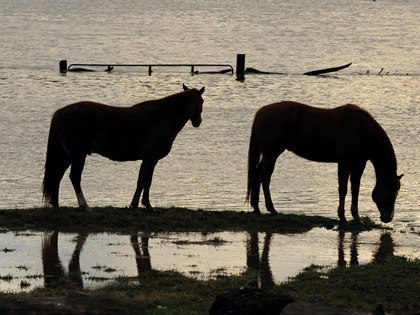
After the Flood: Cleaning Your Horse Farm
Here’s how to get your farm back to normal so your horses have a safe and comfortable place to, once again, call home.

Here’s how to get your farm back to normal so your horses have a safe and comfortable place to, once again, call home.

Three practitioners share advice on how to best care for your horses following a disaster.

Are you ready to help your horse if water rises during a storm? A senior meteorologist from the University of Kentucky offers advice.

He might seem perfect—but before you call him yours, determine if a horse is sound and serviceable for the job at hand and if you can live with his inevitable flaws.

Italian researchers found higher-placed haynets significantly shorten horses’ back muscles and change their jaw angles as they eat.

Find out how to keep you, your prone-to-worry horse, and those around him safe.

Dr. Camie Heleski of the University of Kentucky talks about research into cohousing for stallions.

Researchers gave horses access to shade and misting curtains on hot days. How the horses used them depended on the individual.

Island horses have the same health and welfare needs as any horse, but where they live presents a unique set of advantages and disadvantages for their owners and veterinarians.

High-tech arena surfaces, or footing, create the field-of-play foundation for equine athletes at the Tokyo Olympics.

Learn about this difficult-to-manage allergic reaction to the saliva of biting insects in our visual guide.

Alternating or commingling cows with horses on pastures appears to effectively reduce strongyle burdens in both species, according to two studies.
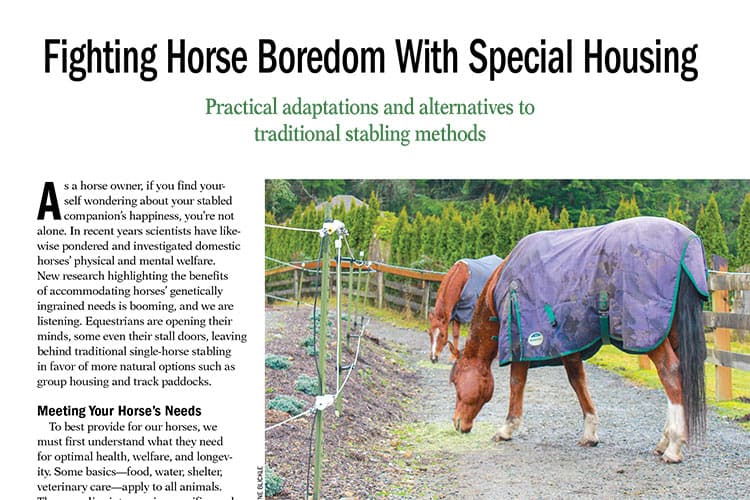
Horse owners are opening their minds, some even their stall doors, leaving behind traditional single-horse stabling in favor of more natural options such as group housing and track paddocks.

Researchers found an inverse relationship between length of paddock turnout and risk of soft tissue injuries in nonelite horses.

The bill has bipartisan support and is co-sponsored by nearly half the U.S. Senate.

Researchers investigated the degree to which boots and wraps impair convection cooling—potentially damaging tendon cells—during exercise.