
Is Early Detection of Arthritis in Horses Finally a Reality?
Radiographs (X rays) and low-field MRI appear to be useful tools for diagnosing early-stage arthritis.

Radiographs (X rays) and low-field MRI appear to be useful tools for diagnosing early-stage arthritis.

Dr. Udeni Balasuriya of the University of Kentucky’s Gluck Equine Research Center shares information about diagnosing equine herpesvirus-1 and interpreting test results.

Discover what flexing a joint can tell a veterinarian about a horse’s soundness.
Dr. Rachel Buchholz explains how bone scans work and how veterinarians use them to diagnose unsoundness in horses.

As prevalent as EIPH is, we still don’t fully understand this potentially performance-limiting condition; here’s what scientists are trying to find out.

Shock wave is a noninvasive, nonsurgical therapy for orthopedic conditions. Learn how it can help your horse.

Recently, a biomarker called SAA has become a buzzword, garnering attention from the equine veterinary community for its ability to indicate inflammation. So just what is SAA and why are so many veterinarians and researchers starting to analyze it?
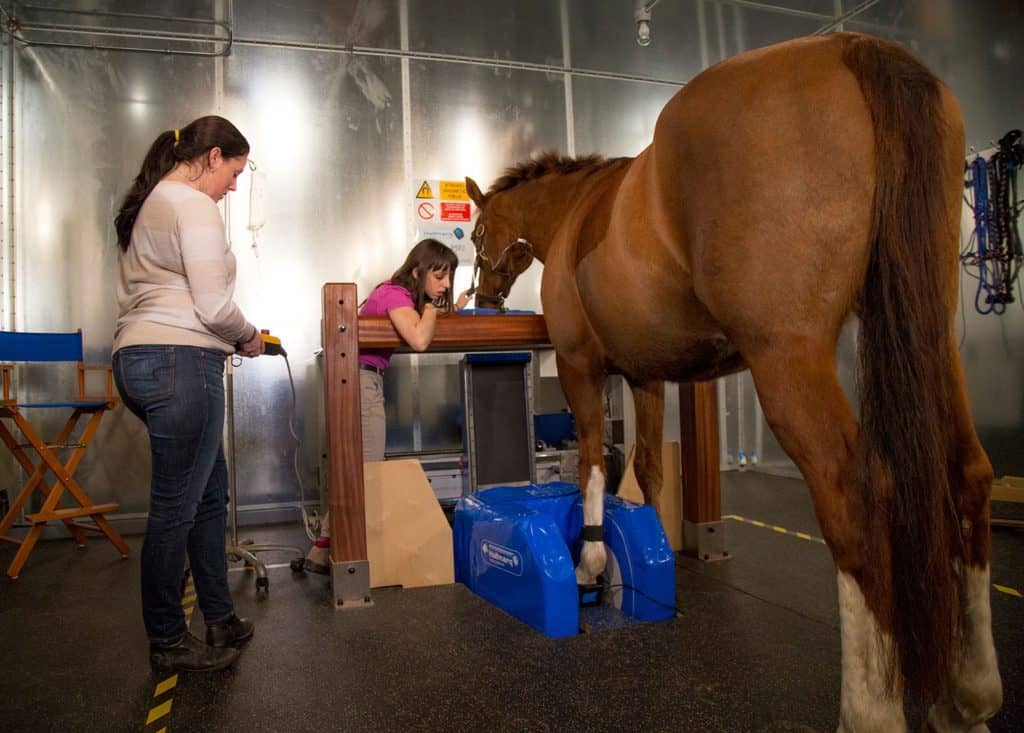
Learn about the standing MRI process step-by-step and take a look inside the equine foot.

Learn why magnetic resonance imaging (MRI) considered the “gold standard” for diagnosing equine lamenesses and get your questions answered about how MRI can help your horses during this live event.

Find out why standing MRI is useful for identifying complex issues in horse hooves and limbs.
Blood testing can provide important information, but it almost always needs to be interpreted relative to the clinical examination findings, history, and additional testing in order to arrive at an accurate diagnosis of the problem.

FEI veterinarian Dr. Kent Allen of Virginia Equine Imaging shares interesting equine lameness cases from his practice. Sometimes it takes some detective work to find true cause of lameness. Part 3 of 3.

U.S. Eventing team veterinarian Dr. Mark Revenaugh of Northwest Equine Performance shares challenging lameness cases from his practice. With lameness, things are not always as they first appear! Part 1 of 3.

Respiratory-related health conditions are the second leading cause of poor performance in athletic horses. Learn more about equine respiratory health with this easy-to-follow visual guide.

Veterinarians have tools to help them make educated judgments about lamenesses, their causes, and prognoses.
Diagnostic testing is rarely a one-size-fits-all proposition. Here’s what you need to know.






