What does it take to optimize the equine immune response and fight off disease?

Could your horse’s diet, workload, and environment undermine his immune system, leaving him vulnerable to infectious diseases, allergies, and delayed healing? Very much so, experts say. “Horses are susceptible to various stressors that can compromise immune function over time,” says Samuel White, PhD, associate professor and head of projects at York St. John University, in England. With expertise in applied immunology, White has studied culprits of equine immunosuppression. So far, excessive exercise, poor nutrition, chronic stress, and prolonged environmental exposure have made the list.
In this article White, along with an internal medicine specialist and an equine nutrition consultant, demonstrates the complex connection between a horse’s immune health, environment, and lifestyle.
Blank Slate: Equine Immunity at Birth
Unlike humans, who come into the world protected by antibodies acquired in utero, foals develop inside multilayered epitheliochorial placentas that only allow minimal maternal transfer of antibodies to the fetus. This lack of immunity transfer during pregnancy makes newborn foals’ immune systems naive (vulnerable) at birth.
“Equine neonates depend on their dams’ antibody-rich colostrum for early protection against infectious agents,” says Allen Page, DVM, PhD, assistant professor in the Department of Veterinary Science at the University of Kentucky’s Maxwell H. Gluck Equine Research Center, in Lexington. Fortunately, beyond the initial reliance on colostrum, this lack of immunity at birth doesn’t appear to put equids at a disadvantage later in life, and Page hasn’t come across any long-term effects from this early vulnerability.

Immunity Through Vaccination
Another key characteristic of the equine immune system is a shorter and less robust immune response to vaccines compared to humans, says Jeremy Frederick, DVM, Dipl. ACVIM, owner of Advanced Equine of the Hudson Valley, an ambulatory equine veterinary practice based in Wappingers, New York. These factors explain why horses need annual or biannual boosters, whereas people can maintain adequate immunity against a particular disease for a decade or more post-vaccination. “Horses generally have lower levels of memory cells that produce long-lasting … lymphocytes (white blood cells that produce antibodies to fight infection), which means immunity from vaccines wanes faster, necessitating more frequent boosters,” Frederick says. “This is particularly true for respiratory viruses (influenza and equine herpesvirus, aka EHV) and mosquito-borne encephalitis viruses (mainly EEE and WEE).”
He also explains that horses encounter more infectious agents than humans, particularly those from other animals, insects, and the environment. This contributes to their need for more frequent vaccinations. “This effect is compounded when horses regularly travel to events, shows, or new environments where they interact with unfamiliar animals and environments,” Frederick adds.
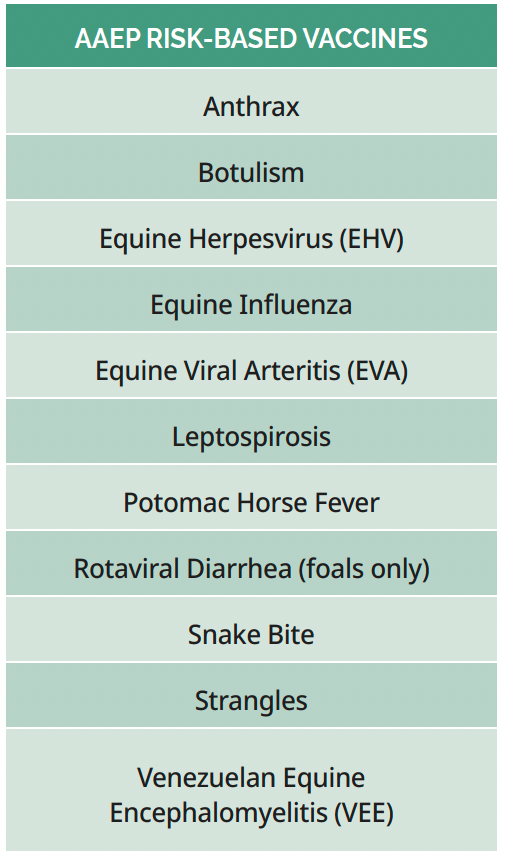
So, how can you maximize the protective effects of your horse’s vaccines? “Firstly, cover your bases by working with your veterinarian to ensure your animals are on a proper vaccination schedule,” Frederick says. The American Association of Equine Practitioners (AAEP) provides a list of core vaccinations that every U.S.-based horse should receive at least annually and additional risk-based vaccines depending on exposure risk.
Some horse owners have their veterinarians draw blood to check antibody titers before (or instead of, depending on results) administering annual boosters. “However, since this is an added expense and there are no established protective levels for most diseases, few clients choose to check titers regularly,” Frederick says. “Therefore, annual or biannual vaccinations are recommended for most horses.”
A Dusty Living Environment
“The barn environment plays an important role in immune health,” says White. Most stabled horses eat, sleep, and live on dusty, ammonia-laden shavings, with brooms (or worse—leaf blowers) stirring
up additional dust and other harmful respiratory triggers. “Good ventilation and low-dust bedding reduce respiratory irritants and help maintain respiratory health,” White says. “Ensuring feed and bedding are clean and stored properly minimizes exposure to harmful spores and bacteria, limiting immune stress.”
Don’t Overlook Nutrition
Nutritional deficiencies can harm horses’ overall health, including the immune system. “A diet lacking in vitamins, minerals, or antioxidants can absolutely weaken the immune system, making horses more vulnerable to infections,” says White. “Horses with poor or unbalanced nutrition may also experience a compromised gut microbiome.”
In recent years scientists established a direct link between gut microbiome health—that of the community of microbes living in the cecum and large intestine—and systemic immunity1. “A healthy microbiome aids nutrient absorption and reinforces the gut’s barrier, reducing inflammation and leakage and strengthening systemic defenses,” White says. “Essential nutrients, including vitamin E, selenium, zinc, and copper, are integral to immune function at the cellular level. They allow immune cells to function properly.”
How can you support your horse’s microbiome and immune health through nutrition? Ofelia Del Principe, certified independent equine nutrition consultant and the owner of Whitfield Equine Nutrition LLC, in High Falls, New York, says the answer begins with the basics. “Supporting equine immune function starts with feeding a balanced diet built on a foundation of forage that meets all of the individual’s nutrient requirements,” she says.
“If we need to further support a horse’s immune system, we can look into supplementation,” Del Principe adds. “Supplementing with the antioxidants vitamin C and vitamin E, omega-3 fatty acids, yeast, and/or certain fibers may improve immune function, but I always give a caveat: Even the most judiciously selected supplements will do little to nothing if the horse is not already eating a balanced diet,” she says.
Stress and the Immune System
In people glucocorticoids (GCs), notably the stress hormone cortisol, are widely recognized for suppressing the immune system2. “Chronic stress is a major contributor to immunosuppression in horses as well,” says White. “Horses are sensitive to environmental changes, transport3, and social disruptions within the herd, all of which can increase cortisol levels and reduce immune resilience. As such, chronic stress has been shown to impair immune responses, making horses more susceptible to infections or triggering latent viruses (to become active).” Equine herpesvirus is a prime example of this phenomenon.
Fortunately, just like nutrition, horse owners can influence stress. “Minimizing stress through consistent routines, stable herd dynamics, and controlled exposure to new situations can limit immunosuppression,” explains White. “Furthermore, reducing exposure to environmental allergens, particularly for horses prone to conditions like asthma and insect bite hypersensitivity (IBH), can lessen immune strain and prevent unnecessary immune activation.”
How Exercise-Induced Stress Impacts the Horse
The body keeps the score, and stress from physical exertion counts toward that tally. “Regular exercise is beneficial for overall health, but overtraining of performance horses can elevate cortisol levels and reduce lymphocyte counts. Horses subjected to continuous high-intensity training often experience slower recovery times and higher incidences of respiratory infections, highlighting the importance of balanced exercise with adequate rest,” explains White.
Overtraining syndrome (OTS) caused by excess training and the lack of proper recovery can lead to temporary immunosuppression in equine athletes, say scientists who in a 2023 study found detrimental effects of OTS on the immune system in racing-bred Quarter Horses4. In another study, researchers found the immunophysiological responses of horses after exercise were breed-dependent to some extent. The authors found Thoroughbreds are less sensitive to exercise-induced stress than Korea’s native stocky Jeju breed, for example5.
Immunosenescence
“Aging negatively affects the immune system in what is called immunosenescence,” explains Page. In aging horses immunosenescence manifests as weakening immunity, leading to a reduced antibody response to vaccination. “This can be seen as the immune system having trouble responding to a new infectious pathogen (disease-causing organism) and/or vaccines while the ability of some immune cells to proliferate decreases,” he says, an explanation supported by recent literature6.
Immunosuppression from Drugs
“Immunosuppressive treatments like corticosteroids, while effective in controlling inflammation and allergic symptoms, can increase a horse’s vulnerability to infections by broadly suppressing immune function,” warns White. “These medications reduce immune cell activity, leaving the body less capable of fighting pathogens.” Long-term or high-dose use of steroids can lead to an increased risk of infections and, in certain metabolically prone horses, the debilitating hoof disease laminitis.
As for the cost-benefit analysis of corticosteroids relative to immune function, “the commonly used drugs dexamethasone and prednisolone can indeed make horses more vulnerable to infections and diseases,” says Frederick. “But this is a dose-dependent effect, so at lower doses typically used in conditions like allergies, the risk is low. However, at higher doses, we can see a reduced ability to fight off pathogens like bacteria, viruses, fungi, and internal parasites.”
Frederick recommends working with your veterinarian to reach the lowest effective dose of corticosteroids. White agrees. “Long-term, a comprehensive approach focusing on preventive care, nutrition, and environmental management is essential for protecting these horses and reducing the need for prolonged high-dose immunosuppressive drugs,” he says.
Take-Home Message
“Horses require more frequent vaccination than humans due to several factors related to their immune system, lifestyle, and environmental exposure,” says Frederick. Beyond following veterinary vaccination recommendations, “horse owners can mitigate threats to their animals’ immune health through appropriate exercise, balanced nutrition, stress reduction, and environmental control,” White adds. “Providing a stable foundation for immune health ultimately helps horses resist disease and recover more effectively when challenges arise.”
References
1. Kauter A, Epping L, Semmler T, et al. The gut microbiome of horses: current research on equine enteral microbiota and future perspectives. Anim Microbiome. 2019;1(1):14.
2. Yeager MP, Guyre CA, Sites BD, Collins JE, Pioli PA, Guyre PM. The Stress Hormone Cortisol Enhances Interferon-υ–Mediated Proinflammatory Responses of Human Immune Cells. Anesth Analg. 2018;127(2):556–563.
3. Miller AB, Harris PA, Barker VD, Adams, AA. Short-term transport stress and supplementation alter immune function in aged horses. PLoS ONE. 2021;16(8):e0254139.
4. Wilson J, De Donato M, Appelbaum B, Garcia CT, Peters S. Differential Expression of Innate and Adaptive Immune Genes during Acute Physical Exercise in American Quarter Horses. Animals. 2023;13(2):308.
5. Khummuang S, Lee HG, Joo SS, Park JW, Choi JY, Oh JH, Kim KH, Youn HH, Kim M, Cho BW. Comparison for immunophysiological responses of Jeju and Thoroughbred horses after exercise. Asian-Australas J Anim Sci. 2020;33(3):424–435.
6. DeNotta S, McFarlane D. Immunosenescence and inflammaging in the aged horse. Immun Ageing. 2023;20(1):2.
7. Birras J, White SJ, Jonsdottir S, Novotny EN, Ziegler A, Wilson AD, Frey R, Torsteinsdottir S, Alcocer M, Marti E. First clinical expression of equine insect bite hypersensitivity is associated with co-sensitization to multiple Culicoides allergens. PLoS ONE. 2021;16(11):e0257819.