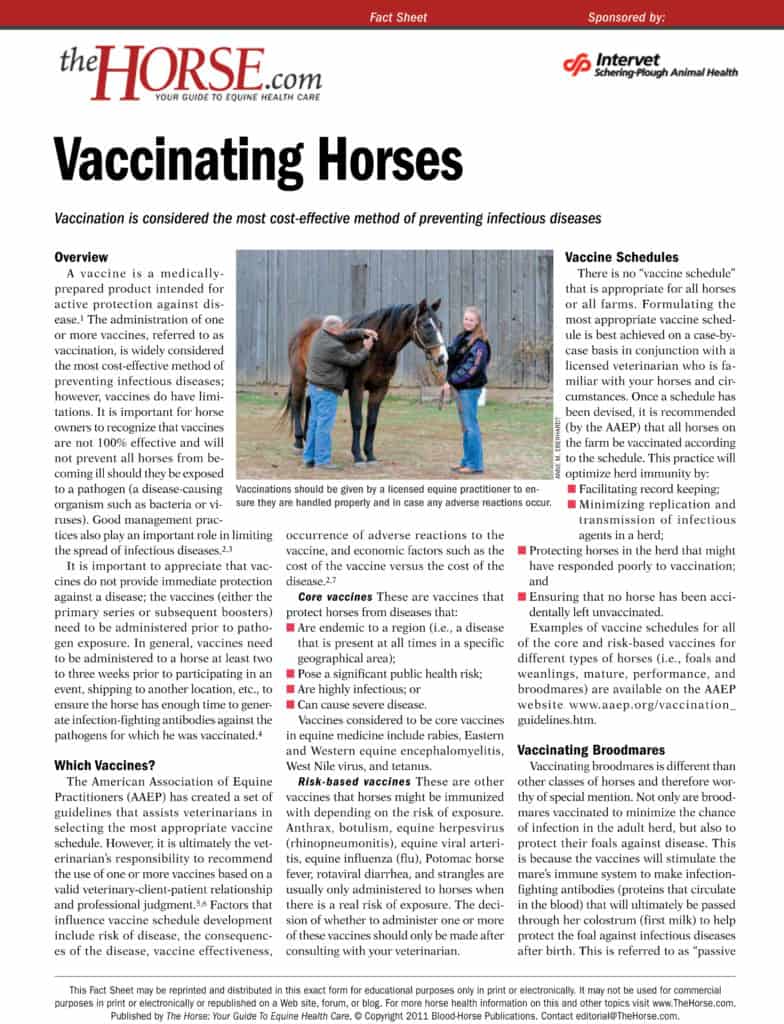
Vaccinating horses is generally considered to be the most cost-effective method of preventing infectious diseases; however, vaccines do have limitations.

An orphaned Thoroughbred foal named Jerry who was fostered by a rescued mare at World Horse Welfare has been reunited with his grateful owner.
When Jerry lost his own mother last August, his worried owner contacted the National Foali
Breed-specific growth models help fine-tune feeding recommendations for young horses in the near future.
The thought of your new foal becoming infected with worms is a bit too much to bear for many horse owners. All it takes is one face-to-face meeting with a squirmy white roundworm, the type of parasite most common in horses under two years of ag

Dr. Alan Ruggles of Rood & Riddle Equine Hospital discusses some of the advances in management of septic orthopedic disorders in foals.
Proteins, composed of essential and nonessential amino acids, are important nutrients for horses.
Mare nutritional status is a critical component in foal health from conception through weaning.
Discussion of the many ways to teach young horses/foals to submit to humans; from imprinting to halter training, tying, grooming, and much more.
Questions: What is the best age to wean a foal? Is it a good/bad practice to take the afterbirth away from the mare right away so the veterinarian can check it? In the covering barn, why does the foal always get upset when the stallion…?
In 2009 the AAEP Foundation conducted a survey to assess the thoughts and opinions of the membership in defining and prioritizing the needs for equine health research. This followed an initial survey in 2003 to establish needs for equine research…
Fetal heart rate monitoring can help veterinarians easily and reliably assess the health of the unborn foal.
A recent study of coffin bone (distal phalanx) fractures in foals found they were far from rare. In fact, all 20 of the Warmblood foals in the study (all foals on a particular farm in one season) had fractures at some point in their first year of life.
Osteoarthritis of the distal (lower) hock joints is a common performance problem in sport horses.
The time to pull out the thermometer and stethoscope to check your horse’s temperature, pulse (heart rate), and respiration (TPR) for the first time is not when he’s looking a little puny and you and the veterinarian are on the phone trying to decide whether it’s an emergency. Instead, these baseline measurements should be part of a horse’s routine care.