Ulcers… For Life?

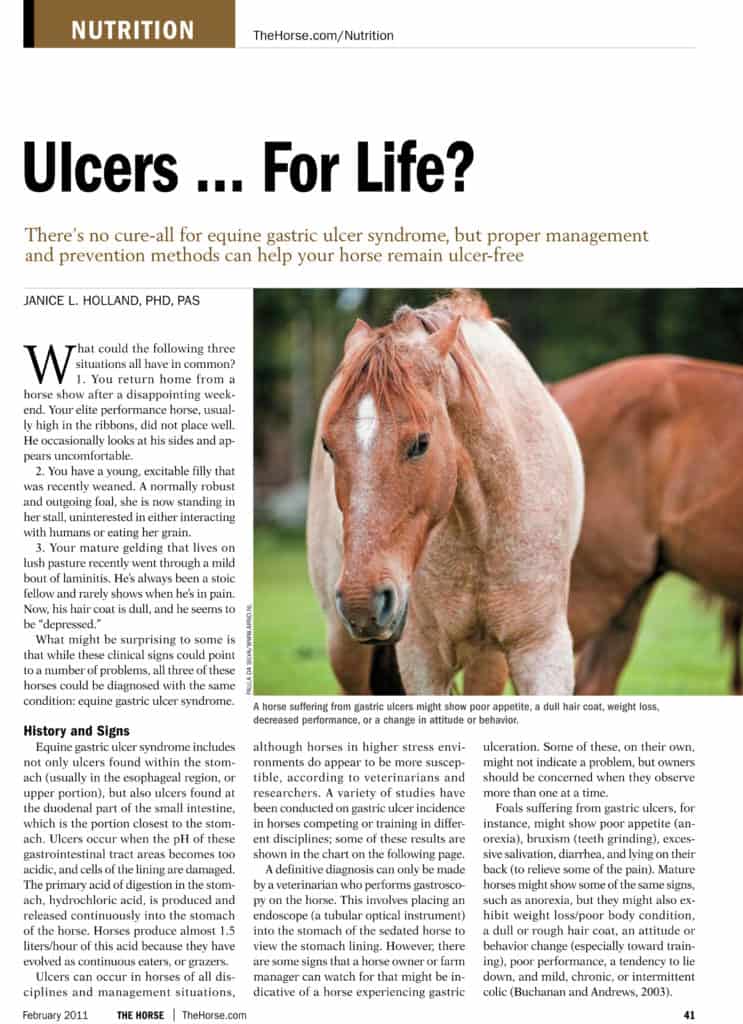
Ulcers can occur in horses of all disciplines and management situations, although horses in higher stress environments do appear to be more susceptible. There’s no cure-all for equine gastric ulcer syndrome, but proper management and prevention methods can help your horse remain ulcer-free.

Read More

Neuroaxonal Dystrophy in Quarter Horses

Dr. Carrie Finno of the University of California, Davis, uses several case videos to describe the neurologic disease neuroaxonal dystrophy (also called equine degenerative myeloencephalopathy) in horses.

Read More

Cold Weather Colic in Horses

Cold winds and changing winter weather might not seem like contributing factors for equine colic; however, these conditions can foster changes in routine and eating habits that could affect your horse’s well-being.

Read More

Samples Needed for Wobbler Syndrome Research

On a warm spring night everyone in the barn is eagerly awaiting a new foal’s arrival. The wait is rewarded with the birth of a big, strong, and beautiful colt. During the next 12 months the foal thrives. The owners dream of having a future champion until one morning the farm manager notices the colt’s gait is abnormal, and he looks somewhat incoordinated (ataxic) in his hindquarters.

Read More

Microbial Colonization of the Foal’s GI Tract

Colonization of the foal’s GI tract by pathogenic organisms can lead to diarrhea. Research has focused on identifying organisms responsible for the diarrhea, but less research has looked at what allows the pathogenic organisms to become established.

Read More
equine rotavirus; r. equi; Sick Newborn Foal at Hospital, assessing foals' fluid volume

R. Equi: Manifestations, Pathogenesis, and Diagnosis

R. equi is a dangerous pathogen that causes pneumonia in foals that are generally between the ages of 3 weeks and 5 months. In cases that caretakers and veterinarians catch early on, the foal can make a full recovery with proper treatment. However in more serious cases, the mortality rate is quite high.

Read More

Ocular (Eye) Surface Failure in Horses (AAEP 2010)

Update on what veterinarians and horse owners need to know about ocular (eye) surface failure (such as corneal ulcers) in horses, from Dr. Dennis Brooks of the University of Florida. (Presented at the 2010 American Association of Equine Practitioners convention, Milne State-of-the-Art Lecture)

Read More

In-Depth: Equine Piroplasmosis (AAEP 2010)

What horse owners need to know about piroplasmosis in horses, from Dr. Josie Traub-Dargatz of Colorado State University. (Presented at the 2010 American Association of Equine Practitioners convention)

Read More
feeding weanling horses; feeding weanlings

What’s In Your Horse’s DNA?

Geneticists have created tools and tests that help horse breeders select for healthy foals. Furthermore, access to the equine genome means scientists can examine common diseases and conditions and find ways to prevent (and one day treat) them.

Read More

More From The Horse

spring pasture, turnout tips, horse turn out, horse in pasture, grazing, spring, spring turnout
Horses in their stable
What's New With Weaning?
hives

Stay on top of the most recent Horse Health news with

FREE weekly newsletters from TheHorse.com

Weekly Poll

sponsored by:

How often do you apply fly spray to your horse during peak fly season?
158 votes · 158 answers

Create a free account with TheHorse.com!

The Horse
Privacy Overview

This website uses cookies so that we can provide you with the best user experience possible. Cookie information is stored in your browser and performs functions such as recognising you when you return to our website and helping our team to understand which sections of the website you find most interesting and useful.